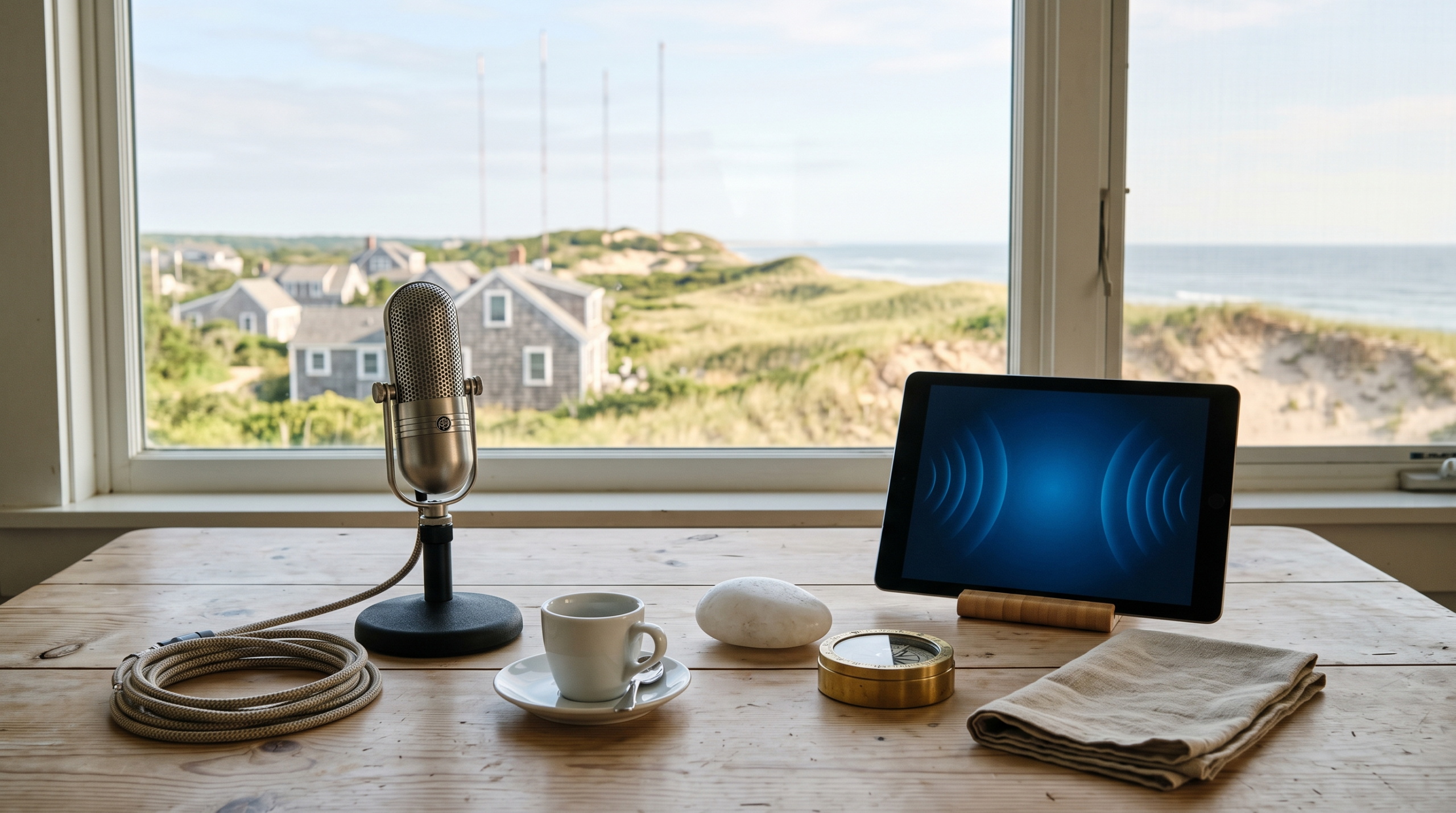
AI consulting podcast as lead engine rests on a reframe that changes every production decision after it: the show’s most valuable audience is its guest list. The genre assumes podcasts work like broadcasting — build an audience, monetize the attention — and then measures itself into despair against that model (the median show’s download counts are humbling, and a consulting founder chasing broadcast-scale listenership is playing the video library’s lottery with worse odds). The guest-first machine inverts it: the podcast is an access instrument — a professionally legitimate reason to spend forty-five recorded minutes with anyone in the vertical the practice serves: the multi-location med spa owner, the HVAC company president, the practice-management consultant whose referrals shape the market, the association director who books the conference speakers — people who ignore cold pitches and accept interview invitations, because the invitation flatters, the format serves their story, and the ask carries no pitch at all. Run for a year at cadence, the machine produces the vertical’s warmest possible relationship map — dozens of ideal buyers and referrers who’ve each had a generous hour with the founder, heard the method’s questions from inside, and joined a permanent, legitimate relationship — and that, not the download chart, is the engine: the show that converts guests, their networks, and the credibility halo, while the modest listenership compounds quietly as a bonus. (Everything here is method, not results promises; individual results vary.)
The channel’s market context, from the standing frame: according to McKinsey’s Superagency in the Workplace report (2025), 92% of companies plan to increase their AI investments over the next three years, yet only 1% describe their AI deployment as mature — and the maturity gap’s stories live with exactly the people the guest list targets: the owners who’ve tried things, the operators mid-mess — interviews that produce simultaneously the relationship (the engine’s product), the market intelligence (the practice’s research), and the content (the flywheel’s raw material), three yields per recorded hour, which is the channel’s real economics. (Individual results vary.)
This guide is the machine’s build: the show design (positioned for the guest you want, not the audience you imagine), the guest engine (the target list, the invitation, the booking system), the interview craft (the hour that creates the relationship), the follow-through system (where the engine actually converts — most shows skip this entirely), the production doctrine (minimum viable, sustainable), and the honest realities.
The Show Design — Built for the Guest You Want
Every design choice serves the guest list: the premise flatters the guest’s expertise, not the host’s (“Operators of [Vertical]: how the best [clinic/contracting/firm] owners actually run their businesses” — a show about them, which is why they say yes; the AI angle arrives inside the conversation, never on the marquee), the title and positioning speak the vertical’s language (the owner should see the show and think “that’s about people like me” — the practice’s niche doctrine applied to the feed), the format respects an owner’s calendar (thirty to forty-five minutes, recorded remotely, one scheduling link, zero prep demanded of them — the yes made effortless), and the episode’s shape gives the guest a genuinely good experience (their origin story, their operational philosophy, the hard-won lessons — with the practice’s questions woven in as craft, below). The show exists to be accepted, then to be enjoyed, then to be shared by the guest to their own network — three conversions before a single download metric matters.
The Guest Engine and the Interview Craft
The target list. Built like the outbound lists, warmer: the vertical’s ideal buyers (owners at the practice’s target scale — every guest a possible client, every episode a possible discovery call that doesn’t know it yet), the referral layer (the accountants, consultants, and vendors who serve the vertical — one great interview converts a referrer for years), and the amplification layer (association leaders, community voices — the guests whose yes upgrades every future invitation). The invitation. One-to-one, manual, per the standing outreach posture (email or LinkedIn DM, the channels’ full discipline inherited — identified, researched, pressure-free): the specific-praise opener (their business, actually researched), the premise (“I host a show about how the best operators in [vertical] run their businesses — I’d love to have you on”), the effortless logistics, and no pitch anywhere — the invitation is the entire ask, and its cleanliness is the acceptance rate.
The interview craft. The hour’s architecture: generous first (two-thirds of the clock on their story and philosophy — the founder listening hard, following up specifically, making the guest brilliant: the experience they’ll remember and repeat), curious second (the woven questions that serve the practice without ambushing the guest: “where does your front desk lose the most time?”, “what happens to calls after six?”, “what have you tried that didn’t work?” — discovery-call questions wearing interview clothes, honestly: the guest is teaching the market, and the founder is learning it, on the record, with permission), and never sold to (the perimeter that protects the machine: no pitch in the interview, ever — the guest who feels sold to warns the vertical; the guest who feels heard refers it). The intelligence yield gets processed like everything: the recurring pain points feed the blog’s keyword spine, the objection language feeds the sales scripts, the tool complaints feed the teardown genre — the show as the practice’s standing research program.
The Follow-Through System and the Production Doctrine
Where the engine converts — the two weeks after. Most shows record, publish, and wait; the machine works its follow-through: the same-week thank-you with the episode’s best moments pulled for the guest’s easy sharing (their network hearing them praised — the amplification conversion), the personal note on the one operational thread the interview surfaced (“you mentioned the after-hours calls going to voicemail — if you ever want a fifteen-minute look at what that’s costing, happy to run the numbers, no agenda” — the smallest door, opened once, pressure-free, per the outbound doctrine’s DNA), the newsletter feature (the episode’s finding becoming the letter’s next issue — consented, per the rules), and the relationship’s maintenance (the guest joins the practice’s warm map permanently: the occasional useful note, the holiday check-in, the referral gratitude — the network the machine was built to build). The conversion path is patient by design: guests become clients on their own timing, referrers immediately, and evangelists forever — the engine’s ledger tracks all three.
The production doctrine. Minimum viable, sustainably held: remote recording on a reliable platform, the microphone investment (the one non-negotiable, per the video post — and the host’s audio matters more than the guest’s), light editing (trim, level, ship — no sound design arms race), a simple fixed intro/outro (the positioning line and the one CTA — the newsletter, always: the show’s listeners route to the owned channel), and the repurposing spine at full strength (each episode yielding the newsletter finding, two or three clip posts for LinkedIn, and a video-library crosspost where the conversation earns it — the flywheel’s fourth spoke turning the others). Cadence honest to capacity: biweekly sustained beats weekly abandoned — the guest engine works at any cadence the founder can actually hold. We do not build the AI. We implement it — and the show is the implementing’s listening tour, one generous hour at a time. (Method; individual results vary.)
Why Guest-First Beats Broadcast
The structural recommendation: build the podcast as a guest-first access machine — premise for the guest, invitation without pitch, interview that makes them brilliant, follow-through that opens one small door — and measure relationships, referrals, and closes, because the founder’s scarce hours buy more pipeline through forty warm guest relationships than through any plausible download count.
The reasoning is structural:
- The access asymmetry is the whole case: the owner who deletes cold pitches accepts interview invitations — the show converts the practice’s hardest problem (reaching ideal buyers) into its easiest yes, and no other channel in the system touches that conversion at the top.
- The three-yield hour is founder-calendar economics at their best: relationship, intelligence, and content from the same sixty minutes — the podcast is the only channel where the production is the prospecting is the research, which is what justifies its slot against everything else competing for the week.
- The no-pitch perimeter is what makes the machine durable: the vertical’s owners talk to each other, and a show known for generous hours compounds invitations upward (the amplification layer’s yes gets easier every season) while a show that ambushes guests dies in the same small rooms — the restraint is the strategy.
- And the engine strengthens the whole system: guests become newsletter features, episodes become the letter’s findings and the feed’s clips, the interview intelligence sharpens every script and spine — the flywheel’s spokes all turning faster for the hub the show adds. (Individual results vary.)
I graduated from Vanderbilt. Almost went straight into investment banking. I spent years at Vanderbilt University reading the same labor reports and McKinsey decks that documented the trends now defining 2026 — and I came away with one inescapable conclusion: a salary has a ceiling. Inflation doesn’t.
I decided not to try and outrun inflation with a salary. I replaced my corporate salary by implementing pre-built AI tools we leverage — Intercom AI, Helios AI, and n8n at the core, plus the broader implementation stack — for service businesses with operational gaps they can’t fix on their own.
What Most Articles Won’t Tell You About Podcasting
A few honest realities:
The failure mode with your name on it is the Vanity Broadcast. It’s the show run on the broadcast model’s scoreboard — the founder checking download charts weekly, comparing against shows with production teams, chasing “bigger” guests for reach instead of righter guests for relationships, spending the episode’s scarce minutes performing for an imagined audience instead of listening to the actual human on the call — and it fails twice: first on its own terms (the median niche show’s downloads stay modest for years; the founder measuring broadcast metrics on a relationship machine reads working as failing and quits at month five — the channel’s most common death, and it’s a measurement error), and second on the machine’s terms (the host performing for the chart interviews worse — the guest feels like a prop for content instead of the point of the hour, the generous experience that powers every conversion never happens, and the follow-through gets skipped because the founder’s eyes were on the wrong ledger entirely). The broadcast model isn’t wrong for broadcasters; it’s wrong for a practice whose entire client base is forty relationships — a show with two hundred listeners and forty warm guests is a triumph on the machine’s books and a failure on the chart’s, and only one of those books pays. The tell is any production decision made for the imagined audience at the expense of the actual guest; the cure is the engine’s ledger held firmly — guests booked, relationships warmed, doors opened, referrals and closes attributed — plus the sentence installed where the chart envy reads it: the show’s real audience is sitting across the microphone — make them brilliant, follow through, and let the downloads be the bonus they were always going to be.
The invitation acceptance rate is the channel’s health metric. Righter premise, warmer targeting, cleaner ask — when acceptances dip, fix the invitation before anything else; the machine’s top of funnel is one email.
Season it if cadence scares you. Ten-episode seasons with breaks beat open-ended weekly guilt — the guest engine works in bursts, and the season structure gives every invitation a natural urgency (“we’re booking season two now”) without manufacturing any.
The perimeter travels here fully. Invitations run through email and LinkedIn DM only, manually, per the standing posture — no calling, no SMS, and the interview’s no-pitch rule plus the follow-through’s one-door discipline get the same counsel review as every outreach template; the show’s warmth changes none of the rules. The standing base rates govern at the channel’s natural pace: relationships convert in quarters — the machine is infrastructure, measured like it. (Individual results vary.)
According to McKinsey’s Superagency in the Workplace report (2025), 92% of companies plan to increase their AI investments over the next three years, yet only 1% describe their AI deployment as mature. The consultants who own the microphone in 2026 are not the ones with the biggest download charts. They’re the ones whose guest lists read like their vertical’s inner room — forty generous hours, forty warm relationships, and a referral network that started with an invitation carrying no pitch at all.
Book the First Three Guests This Month
The action sequence for ai consulting podcast as lead engine:
This week: The premise drafted for the guest’s eyes; the target list built — ten ideal buyers, five referrers, three amplifiers; the invitation written clean.
This month: The minimum stack assembled (remote platform, the microphone, the scheduling link); the first three interviews booked and recorded; the follow-through system templated.
Per episode: Two-thirds generous, one-third curious, zero pitch; the same-week thank-you and share kit; the one small door opened once; the intelligence harvested into the spine.
Ongoing: The relationship map maintained; referrals and closes attributed; the repurposing spine feeding the flywheel; the chart declined every time the vanity scoreboard offers to replace the engine’s ledger. (Individual results vary.)
Interview your way into the room you can’t pitch your way into. Premise for them. Hour for them. Door opened once. Relationships forever.
The show’s product is the guest list — and forty warm hours in, the vertical’s inner room knows your name the best way it can be known: as the one who listened.
Pick the industry. Take the first step. If you want to see the playbook fully in action – tap here to start.