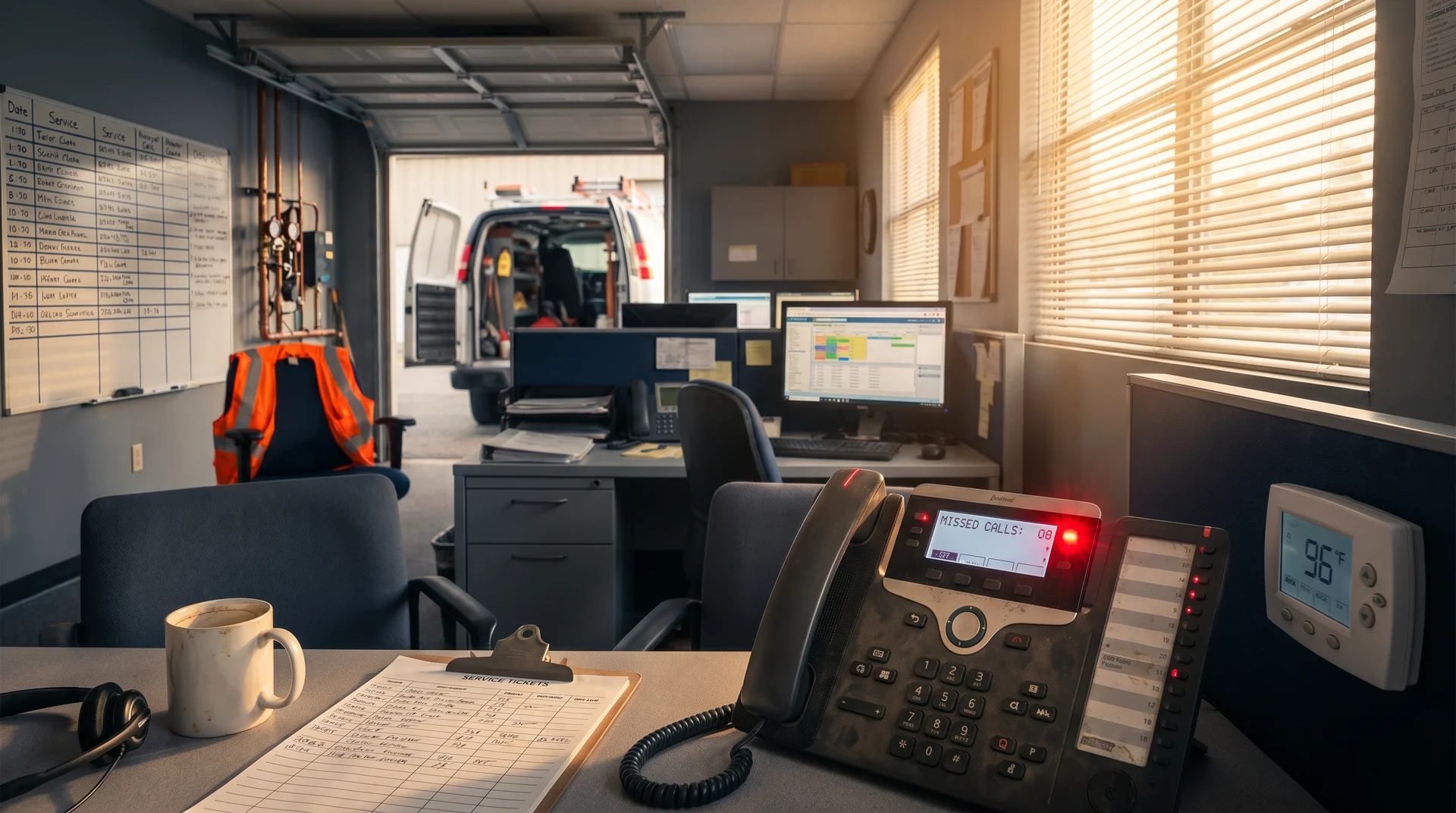
AI for HVAC companies is no longer a futuristic add-on — it’s the single fastest way to plug the largest operational leak in the home services industry. 73% of an HVAC contractor’s annual revenue comes from just six months of the year — June through August, and December through February.
During those six months, call volume can spike 340% above off-season levels. Customers calling at 7 PM on the hottest day of the year — when their AC just died and the kids can’t sleep — will call three contractors in the first ten minutes. Whichever one answers first gets the job. The other two never hear from that customer again.
The math here is brutal. According to industry benchmarking data, the typical HVAC contractor misses 22% of inbound calls during regular operations and 35%+ during peak season. Each of those missed calls costs an average of $350 in immediate lost revenue, with a customer lifetime value of $15,000–$40,000 when you factor in replacement systems, referrals, and ongoing maintenance.
Run that math against a 100-call week with a 22% miss rate, and you’re looking at $7,700 in weekly lost revenue. During peak summer or winter, double it. Over the course of an annual season, the leak commonly runs $300,000–$600,000 for a mid-sized contractor.
This is the largest single operational problem in the HVAC industry. And in 2026, it’s also one of the most solvable.
Why HVAC Contractors Are Uniquely Exposed to Missed Call Revenue Loss
The HVAC business sits at the worst combination of operational pressures of any local service category in America.
1. Demand is intensely concentrated and unpredictable. Most service businesses have relatively flat demand. HVAC doesn’t. A heat wave in your service area can triple your call volume in a single afternoon. A cold snap can do the same in December. There is no realistic way to staff for the peak — hiring enough front-desk staff to handle a 340% summer spike means paying those salaries for nine months when call volume is normal.
2. Customers won’t wait. Industry research shows HVAC customers expect a callback or response within 30 minutes of their initial contact. After that, the majority will contact a competitor. In emergency situations — which is most peak-season calls — customers are calling multiple contractors simultaneously and hiring whoever confirms first. 85% of voicemails are never returned at all because the customer has already booked someone else.
3. After-hours is essentially 100% missed. Industry data shows 62% of HVAC calls come in after standard business hours. Without an AI or live-answer system, all of those calls go to voicemail. Most never call back. They google the next contractor and book them instead.
4. The lifetime value math makes every miss expensive. An HVAC customer represents $15,000–$40,000 in lifetime value when you count the original service call, system replacement (averaging $8,000–$12,000), seasonal maintenance, referrals, and the family they will refer to you. A single missed emergency call during peak season doesn’t just cost $350. It costs a decade of revenue.
The contractors winning in this market are not the ones with the biggest ad budgets. They’re the ones whose phones get answered when the heat wave hits.
What “AI for HVAC Companies” Actually Means in 2026
Beyond the basic “AI receptionist” pitch, here’s what a properly deployed AI stack does for an HVAC contractor.
1. 24/7 AI Voice Reception
The single highest-ROI application of AI for HVAC companies. An AI voice agent answers every inbound call instantly — no rings to voicemail, no hold time, no robotic phone tree.
The AI handles emergency triage (is this a no-cool, no-heat, or routine request?), books appointments directly into your dispatching software, captures customer details and address for the technician, and operates 24 hours a day, 365 days a year. It does not call in sick during a heat wave. It does not take a lunch break at 12:30 PM when the phones are exploding.
2. Emergency Intent Routing
A specifically HVAC-relevant workflow. An AI system can identify the urgency of a call within the first 15 seconds — “my AC is out and it’s 96 degrees” gets routed differently than “I’d like to schedule a spring tune-up.” The first gets booked into the emergency dispatch queue immediately. The second gets booked into the maintenance schedule. Without AI, both calls go to the same general voicemail box and get triaged the next morning — by which point the emergency caller has already hired the next contractor.
3. Missed Call Text-Back
If a call does slip through, an automated text fires within seconds: “Hi — this is [Company]. We just missed your call. What’s going on with your system? I can text you our next available appointment right now.” Industry data shows this single workflow recovers 20–40% of otherwise-lost calls. It’s the most underrated automation in the entire stack.
4. Seasonal Reactivation Campaigns
Existing customer databases are the most underutilized asset in HVAC. AI handles automated outreach for spring AC tune-ups, fall furnace check-ups, system replacement campaigns for aging equipment, and maintenance agreement renewals — at scale, on a calendar, without burning office staff time. Industry data shows a well-run reactivation campaign generates $50,000–$150,000 per year for a mid-sized contractor with a 3,000+ customer database.
5. Speed-to-Lead Web Response
When a homeowner submits a form on your website at 9 PM, the AI responds within 30 seconds with a text that qualifies the lead and books an appointment. Industry data shows responding to leads within 5 minutes increases conversion by up to 400% compared to responding the next morning.
When all five workflows are deployed correctly, the typical contractor moves from 22% missed calls to under 5%, captures 60–80% of after-hours leads instead of zero, and reactivates dormant customers at a rate that exceeds what most paid advertising delivers.
What AI for HVAC Companies Actually Costs
For HVAC owners reading this and trying to evaluate the investment:
Tool-only AI receptionist platforms: $199–$599/month. These are real tools, but they’re software, not solutions. The contractors who buy them and try to deploy them themselves typically see degraded performance within 60 days because nobody is monitoring the system, tuning prompts, or integrating with the dispatching software.
Managed AI implementation for a single-location HVAC contractor: $1,500–$3,000/month plus a one-time setup fee. This covers the full stack — voice reception, emergency triage, missed-call text-back, reactivation campaigns, integration with your existing field service management software (ServiceTitan, Housecall Pro, FieldEdge, Jobber).
Multi-location operators and franchise groups: $3,000–$10,000/month for properly managed deployment with centralized reporting and cross-location optimization.
Compare those numbers to:
- Hiring a dedicated after-hours dispatcher: $4,500–$6,000/month all-in, and they still can’t handle peak season spikes
- Continuing to miss 22% of calls during normal operations
- Continuing to miss 35%+ of calls during peak season
- Continuing to lose $300,000–$600,000 per year in attributable missed-call revenue
The math closes on the first conversation. The only reason most contractors haven’t moved is they don’t know which tools to use, how to deploy them properly, or who to trust to do it right.
That’s the actual gap. Not the technology. The implementation.
Why AI for HVAC Companies Is One of the Strongest Implementation Niches in 2026
For corporate professionals reading this and evaluating whether to build an AI implementation business serving HVAC contractors — a few honest observations.
HVAC is genuinely one of the strongest target industries available right now. The reasons:
The pain is enormous and easy to quantify. Every contractor knows their miss rate is bad. Most don’t know it’s 22%+. Pulling 30 days of call data and showing them their actual leak is a closeable conversation in 20 minutes.
The recurring revenue economics are strong. $1,500–$3,000/month per single-location client. Multi-location contractors pay more. 3–5 clients = a full-time corporate-equivalent income working a few hours a week.
Seasonal urgency drives faster sales cycles. A contractor who lost a $12,000 system replacement to a missed call last summer is not going to wait until next May to fix it. They want it done before the next peak hits.
Maintenance agreement upsell creates additional revenue. A properly run AI system doesn’t just capture inbound calls — it converts them into recurring maintenance plans that compound the contractor’s revenue and your value to them.
Owners control the budget. Family-owned and small-group HVAC companies have one decision-maker who can sign on the spot.
I graduated from Vanderbilt. Almost went straight into investment banking. I spent years reading industry reports and came away with one conclusion: a salary has a ceiling, inflation doesn’t. I decided not to try and outrun inflation with a salary. I replaced my corporate salary by implementing pre-built AI tools we leverage — Intercom AI, Helios AI, n8n — for local service businesses with exactly this kind of operational gap.
HVAC contractors are not technical buyers. They are operators who care about whether the phone rings, whether the job gets booked, and whether the technician arrives on time. The AI doesn’t have to be impressive. It has to be reliable. That’s a much easier problem to solve than most first-time operators expect.
According to McKinsey, 92% of companies have no clear AI strategy, and only 3% currently offer AI implementation services. The HVAC industry mirrors that exactly. The window is wide open. While 99% of people wait for the “right time,” smart operators are locking in HVAC clients before the next peak season hits — because contractors who get burned by missed calls this summer will sign for almost any system that prevents it from happening again.
To see real life examples of AI Implementation operators, view our coaching calls.
What to Look for in an AI for HVAC Companies Implementation Partner
For HVAC owners evaluating their options:
Specialization in home services matters. A generalist AI agency doesn’t understand the difference between an emergency no-cool call and a quote request. A specialist who has deployed across HVAC, plumbing, and electrical understands the dispatching logic and the emergency triage requirements.
Integration with your field service management software is non-negotiable. ServiceTitan, Housecall Pro, FieldEdge, Jobber — your AI needs to talk to whatever you use, or it’s just an answering service.
Ask about peak season performance. Anyone who can’t tell you how their system performed for a comparable contractor during a heat wave or cold snap is not the partner you want.
Expect monthly outcome reporting, not feature reporting. “We captured 47 after-hours emergency calls worth $16,500 in immediate revenue and three replacement leads worth approximately $34,000” is what your monthly report should look like.
The Bottom Line
The HVAC contractors pulling away from their competitors in 2026 are not the ones with the most aggressive ad budgets. They’re the ones whose phones get answered at 7 PM on the hottest day of the year, while their competitors’ calls roll to voicemail.
That gap is going to widen every season. The customer who picks you in July is the customer your competitor lost — and the system replacement you sell them in 2029 is the revenue your competitor will never see.
AI for HVAC companies is not a trend. It’s how the contractors deploying it now are buying the next decade of revenue at this year’s prices.
The phone will ring. The only question is whether something answers.