The Quiet Shift Happening in Corporate America Right Now
If you’re a corporate professional earning $100,000+ a year, you’ve probably noticed something uncomfortable in 2026.
Your salary looks great on paper. But your mortgage payment is higher than it was three years ago. Your grocery bill has roughly doubled. Childcare costs more than a second car payment. And despite every promotion, every bonus, every late night you’ve pulled for your employer — you’re not really getting ahead.
A salary has a ceiling. Inflation doesn’t.
That’s the realization quietly forcing thousands of high-earning professionals to rethink the entire premise of “make more money by working harder at your job.” The smart ones aren’t quitting. They’re not gambling on crypto. They’re not buying franchises. They’re building something far simpler and far more durable: recurring revenue from AI Implementation for local service businesses — using open-source tools that didn’t exist 18 months ago.
One of those tools is Hermes AI Agent, built by Nous Research. And it’s changing what’s possible for solo operators in a way most corporate professionals haven’t caught onto yet.
This post breaks down exactly what Hermes AI Agent is, why it matters, and how it fits into a business model that’s letting professionals stack $1,500–$3,000/month per client in recurring revenue — without quitting their day jobs.
First, Let’s Talk About Why 2026 Demands Residual Income
The corporate professional’s playbook used to be simple: get a degree, climb the ladder, max out the 401(k), retire at 65.
That playbook is broken.
The math has changed in ways that aren’t being talked about enough at quarterly reviews:
- Inflation outpaces salary growth. Your 4% raise feels like a pay cut when real costs are rising faster.
- Single-income stability is gone. Most high-earning households now require two professional incomes just to maintain a middle-class lifestyle.
- Job security is a myth. AI is restructuring entire departments. Even senior roles aren’t safe.
- The wealth gap is widening. The people pulling ahead aren’t earning more — they own assets that generate income while they sleep.
The professionals building real wealth in 2026 aren’t grinding harder. They’re building systems that pay them recurring revenue every month — assets that compound, that don’t require their physical presence, and that they can eventually pass down to their kids.
This is where AI implementation enters the picture. And this is where Hermes AI Agent becomes one of the most important tools you’ve probably never heard of.
What Is Hermes AI Agent?
Hermes AI Agent is an open-source autonomous AI system released on February 25, 2026 by Nous Research, an AI lab led by co-founder and CEO Jeffrey Quesnelle. It’s distributed under a fully open MIT license, which means anyone — including you — can use it, modify it, and deploy it commercially without licensing fees.
Most AI tools forget you the moment you close the tab. Every new session starts from zero. Hermes was built specifically to fix that.
It’s an AI agent that lives on your server, remembers what it learns, and gets more capable the longer it runs. It’s not a chatbot. It’s not an IDE plugin. It’s a persistent AI worker built around what Nous Research calls a closed learning loop: the agent solves a task, writes a reusable skill file, stores the outcome in persistent memory, and improves its own approach the next time it sees a similar problem.
The developer community responded fast. Within weeks of launch, Hermes collected 22,000 GitHub stars and 242 contributors. By April 2026, that grew to over 32,000 stars — making it one of the fastest-adopted open-source AI projects of the year.
Here’s why that matters for corporate professionals thinking about a side income: this is exactly the kind of tool that lets one person operate like a five-person agency.
The Core Idea: An AI That Actually Learns
Traditional AI assistants are brilliant but forgetful. Every session starts from scratch. That’s fine for one-off questions. It’s catastrophic for running an actual business.
Hermes AI Agent solves this through a multi-level memory system that mimics procedural learning:
Skill Documents. When Hermes completes a complex task — debugging a workflow, optimizing a process, building a custom client automation — it synthesizes that experience into a permanent Markdown skill file. The next time you ask it to do something similar, it queries its own library instead of starting from zero. Skills follow the open agentskills.io standard, so they’re portable and shareable across the community.
Cross-Session Memory. Hermes stores conversation history in a SQLite database with full-text search and LLM-powered summarization. It can recall past interactions across sessions, platforms, and devices. Stop a conversation in your terminal at 9 AM, pick it up on Telegram during your lunch break, finish it on Slack after dinner — full context maintained the entire time.
User Modeling. Over time, Hermes builds a profile of who you are, what you work on, and how you like things done — using Honcho dialectic user modeling to deepen this understanding across every interaction.
The practical implication: the longer you run it, the more leverage you get. It’s the opposite of every other AI tool you’ve used.
Key Features That Matter for a Business Owner
1. Multi-Platform Messaging Gateway
Hermes connects to 20+ platforms through a single gateway: Telegram, Discord, Slack, WhatsApp, Signal, Matrix, Mattermost, Email, SMS, Microsoft Teams, Google Chat, DingTalk, Feishu, WeCom, Weixin, QQ Bot, Home Assistant, and more.
For a service business operator, this means one agent can run customer interactions across every channel your clients use — without you having to wire up integrations manually.
2. Scheduled Automations With Natural Language
Hermes includes a built-in cron scheduler that accepts natural language. You can literally say “send me a daily client briefing at 8 AM” and the agent handles it. It runs unattended through the gateway — handling reports, nightly backups, weekly audits, recurring follow-ups. No external scheduling tools required.
This is the part that turns Hermes from “neat AI tool” into “always-on employee.”
3. Subagent Delegation
For multi-step work, Hermes can spawn isolated subagents with their own conversations, terminals, and Python scripts. It’s effectively delegating tasks to multiple AI workers in parallel — without bloating the main agent’s context window.
In business terms: you’re running an entire team off one license, on one server.
4. Six Deployment Backends
Hermes supports Local, Docker, SSH, Daytona, Singularity, and Modal deployments. Daytona and Modal are particularly interesting because they offer serverless persistence — your environment hibernates when idle, costing nearly nothing between tasks. The entire stack runs comfortably on a $5/month VPS.
A $5/month server can host an AI agent that manages clients paying you thousands per month. That’s the math that’s hard to argue with.
5. 40+ Built-In Tools
Web search, browser automation, terminal access, file operations, code execution, image generation, text-to-speech, vision (screen and image analysis), multi-model reasoning. All accessible from the CLI, through any connected messaging platform, or through the OpenAI-compatible API server it exposes at http://localhost:8642/v1.
6. Model Agnosticism — No Vendor Lock-In
Hermes supports over 400 models through Nous Portal, OpenRouter, local backends (Ollama, vLLM, llama.cpp), and any OpenAI-compatible endpoint. No code changes required to swap models. Run a frontier model for hard reasoning, a lightweight local model for routine tasks. All in one agent.
This is critical for a business: you’re not locked into a single provider’s pricing changes or terms of service.
Now Here’s the Part Most Tutorials Skip: The Business Model
Reading about Hermes AI Agent is interesting. Building a business around it is where the actual money is.
Here’s the reality: 36 million small businesses exist in the United States. Almost none of them have a clear AI strategy. According to McKinsey, 92% of companies have no clear AI strategy, and only 3% currently offer AI implementation services. That gap is the opportunity.
Local service businesses — med spas, dental offices, HVAC companies, auto repair shops, car dealerships — are still paying $6,000+ per month for employees doing repetitive, scriptable work. Receptionists handling appointment bookings. Office staff answering the same five questions all day. Inbound lead qualifiers who follow a fixed checklist.
This is exactly the kind of work AI agents now handle better, faster, and at a fraction of the cost.
The business model is simple:
- Pick an industry (start with one — med spas are a great entry point).
- Identify the expensive, repetitive role (almost always front-desk or lead-handling).
- Set up pre-built AI tools (this is where Hermes AI Agent, Intercom AI, Helios AI, and n8n come in).
- Charge a setup fee + monthly recurring management fee (typical pricing: setup fee + $1,500–$3,000/month per client).
- Outsource ongoing support and scale to additional clients in the same vertical.
3–5 clients = full-time income working a few hours a week.
You don’t need a tech background. You don’t need to know how to code. You’re not building AI from scratch — you’re implementing pre-built tools that already work. The skill is in the deployment, the client management, and the system design — not the engineering.
Why Hermes AI Agent Specifically Fits This Business Model
Most AI implementation operators today are stitching together Intercom AI for client-facing chat, Helios AI for voice handling, and n8n for workflow automation. That stack works — it’s what most operators are using right now.
Hermes AI Agent doesn’t replace those tools. It sits underneath them. It’s the persistent operator layer that:
- Remembers each client’s setup without you having to re-explain it every session
- Auto-generates skill files for repeated tasks (so onboarding client #5 is faster than client #1)
- Runs scheduled work unattended — nightly reports, monthly audits, recurring client updates
- Maintains context across messaging platforms so you can manage clients from your phone, your laptop, or your desk
- Scales to subagents when one client’s workload gets complex enough to need parallel processing
A solo operator running Hermes alongside the standard stack can realistically manage 5–10 clients without burning out — because the agent itself is doing the operational memory work that would otherwise eat your weekends.
This is the difference between “I have a side hustle” and “I own a real business asset.”
Getting Started With Hermes AI Agent
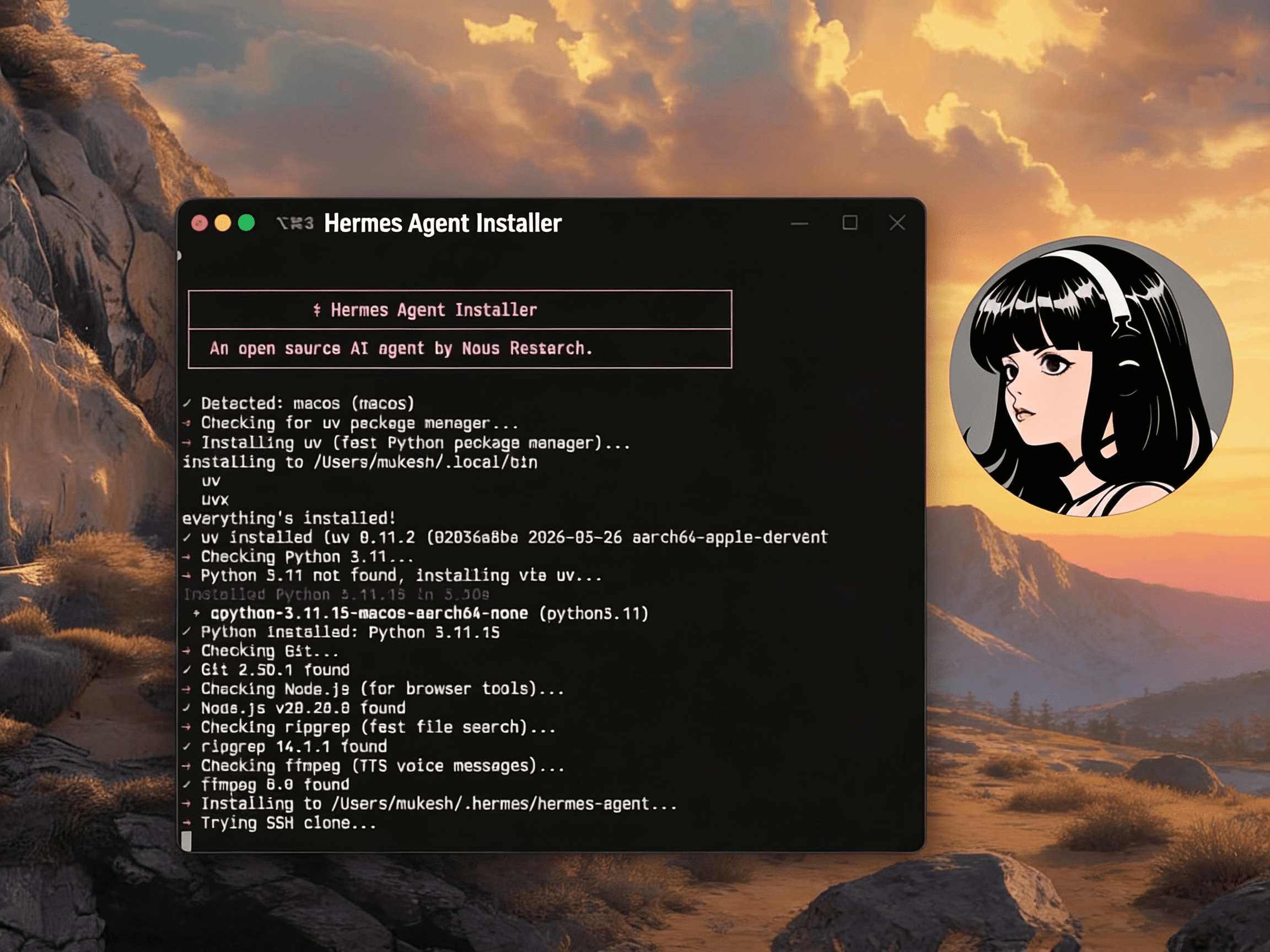
Installation is intentionally friction-free:
# Step 1: Install
curl -fsSL https://hermes-agent.nousresearch.com/install.sh | bash

# Step 2: Configure
hermes setup

# Step 3: Start
hermes
The installer handles uv, Python 3.11, repo cloning, and dependencies automatically. No sudo required. Works on Linux, macOS, and WSL2.
To connect your messaging platforms:
hermes gateway setup
hermes gateway
hermes gateway install  # Installs as a systemd service
For teams using Open WebUI as a frontend, Hermes exposes an OpenAI-compatible API at http://localhost:8642/v1, connectable through Open WebUI’s admin settings in minutes.
For a working AI implementation business, you’ll pair this with Intercom AI (for client-side conversations), Helios AI (for voice), and n8n (for workflow automation). That’s the full operator stack.
How Hermes AI Agent Compares to Alternatives
The most common comparison is to OpenClaw, another open-source agent framework. Here’s how they differ:
| Feature | Hermes AI Agent | OpenClaw |
|---|---|---|
| Skill Creation | Autonomous, auto-generated | Manual plugin configuration |
| Memory | Persistent, cross-session, FTS5 search | Session-based, limited |
| User Modeling | Deep profiling via Honcho dialectic | Minimal |
| Migration Path | Built-in hermes claw migrate command | N/A |
| Learning Loop | Closed, self-improving | Not built-in |
| Deployment | $5 VPS to GPU cluster | Varies |
| License | MIT open source | Open source |
The differentiator is the closed learning loop. OpenClaw is about orchestration and plugin breadth. Hermes is about long-term improvement and autonomy. For a service business running persistent client workflows, that difference compounds significantly over months.
Version Timeline
| Version | Key Update |
|---|---|
| v0.1.0 | Initial launch — February 25, 2026 |
| v0.5.0 | Security hardening (command approval flows, dangerous-pattern blocking) |
| v0.6.0 | MCP support and typed SDK workflows |
| v0.7.0 | “Resilience release” with MiniMax AI partnership (M2.7 models) |
As of May 2026, 32,000+ GitHub stars and a growing contributor base.
The Bigger Picture for Corporate Professionals
Here’s what most $100K+ earners miss: the people building real generational wealth right now aren’t the ones with the biggest salaries. They’re the ones who own systems that generate recurring income whether they’re working or not.
Hermes AI Agent isn’t valuable because it’s a cool open-source project. It’s valuable because it’s one of the most affordable, durable, and scalable building blocks for an AI implementation business — the kind of business that:
- Doesn’t require quitting your job to start
- Generates monthly recurring revenue, not one-time payments
- Scales without proportional time investment
- Can be operated from anywhere with an internet connection
- Becomes an actual asset you can sell or pass to your children
While 99% of people wait for the “right time” to get into AI, smart people are locking in clients right now. The window where local service businesses are dramatically underserved by AI implementation closes the moment everyone catches on.
The salary game is a treadmill. The AI implementation game — built on tools like Hermes AI Agent — is an escalator.
You don’t need to outrun inflation with a paycheck. You can build something that compounds instead.
Want the exact playbook?
>> Tap here and you will access the full breakdown of how corporate professionals are using AI implementation to build $10,000+/month in recurring revenue — without quitting their day jobs.