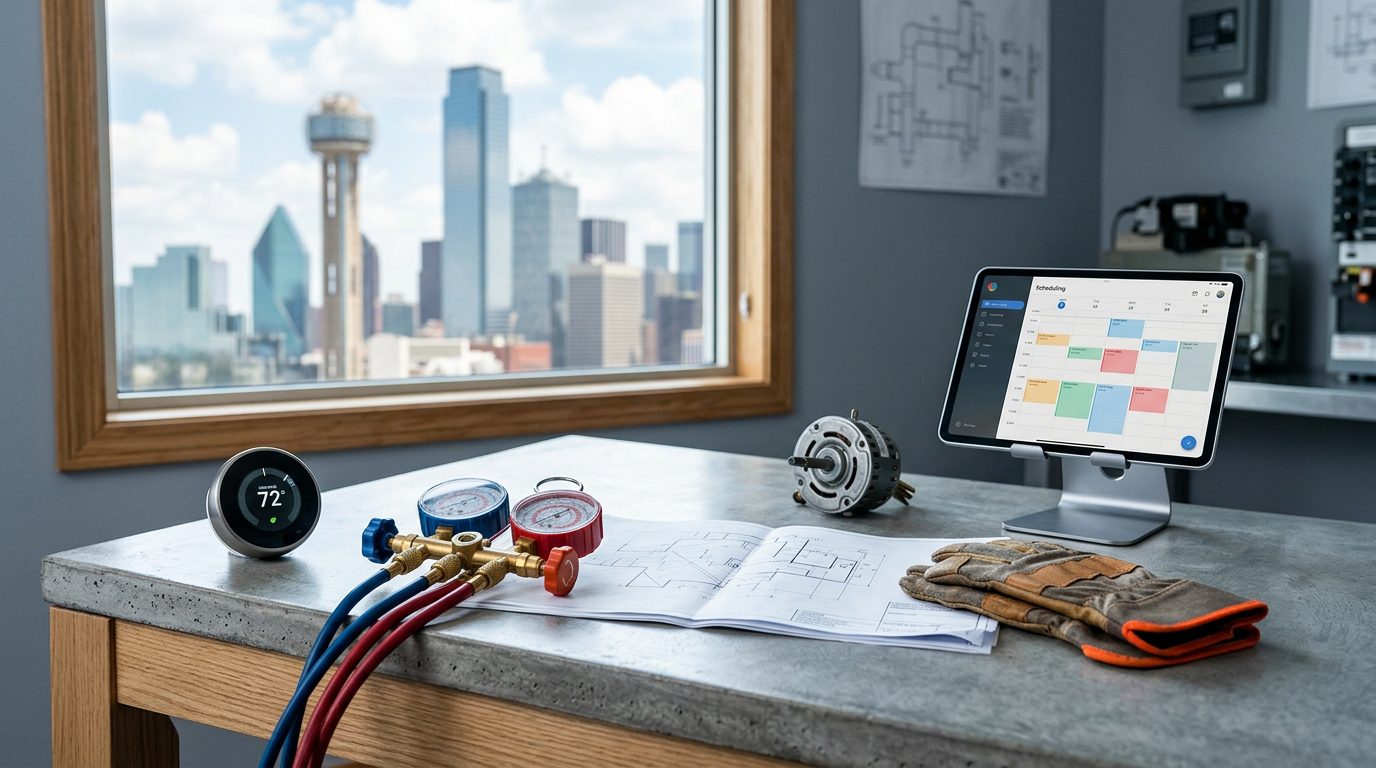
An AI agent for HVAC companies is one of the most immediately profitable systems a heating-and-cooling business can deploy in 2026 — because HVAC demand is violently seasonal, and the busiest week of the year is exactly when the phone overflows and jobs get lost.
When the first heat wave hits, every call is a no-cool emergency and every homeowner is calling three companies at once. The office cannot answer fast enough. Calls roll to voicemail, and the homeowner books whoever picked up first. An AI agent answers every call simultaneously, qualifies the emergency, checks the dispatch board, and books the job — at 6 a.m. on the hottest Saturday of the year, with no hold music and no missed leads. Answering, qualifying, and booking are the exact functions that decide whether an HVAC company captures or forfeits peak-season revenue.
According to Crunchbase News’ tech layoffs tracker, more than 127,000 U.S. tech-sector workers were laid off in 2025, with cuts continuing into 2026, and independent trackers report that a majority of 2026 reductions cite AI or automation as a contributing factor. According to the U.S. Small Business Administration’s Office of Advocacy, there are 36.2 million small businesses in America, accounting for roughly 46% of private-sector employment. According to McKinsey’s 2025 workplace AI research, 92% of companies plan to increase AI investment over the next three years — yet only 1% of leaders call their organizations mature at deploying it. The gap between intent and operational reality is the entire opportunity, and almost none of it has reached the local HVAC contractor.
This guide walks through the AI agent for HVAC companies in 2026: the operational gaps it closes, the seasonal pressure forcing adoption, the exact tool stack that powers it, the rollout playbook, the segments where it returns the most, and the honest realities most vendors won’t tell you. Whether you run an HVAC business or implement AI systems for service companies, the math is concrete. The companies that win the next decade are not the ones with the biggest ad budget — they are the ones who book every call when the heat index spikes.
Why HVAC Companies Are Disproportionately Valuable for AI Implementation
Let me catalog the operational gaps explicitly, because most people significantly underestimate how much revenue an HVAC company loses to problems an AI agent solves immediately.
The peak-season overflow problem. HVAC demand concentrates into a few brutal weeks. During those weeks, inbound call volume can exceed the office’s capacity by several multiples. An AI agent handles unlimited simultaneous calls, which is the single hardest thing for a human office to do.
The missed-call problem. Outside the peaks, calls still go unanswered while techs are on jobs. Each missed call is a service ticket worth hundreds to thousands of dollars. The agent answers all of them.
The emergency-qualification problem. No heat in January and no cool in July are emergencies that need fast triage — system type, age, symptom, urgency. An AI agent runs that intake consistently and routes correctly.
The maintenance-plan problem. Maintenance agreements are the most valuable recurring revenue in HVAC, and most companies under-sell and under-renew them. An agent can pitch plans at booking and run automated renewal sequences. This is recurring-revenue capture running on autopilot.
The speed-to-lead problem. HVAC buyers comparison-shop fast. The first company to respond to a Google or form lead usually wins. The agent fires an instant text-back within seconds.
The after-hours problem. Systems fail at night and on weekends. The agent captures and books those leads instead of losing them to voicemail.
The review problem. Reviews drive local rankings; an automated post-job request lifts the Google Business Profile that feeds the entire funnel.
The follow-up problem. Big-ticket replacement estimates die in inboxes. The agent chases open proposals until they close.
The reactivation problem. Past customers need tune-ups, filter changes, and eventual replacements. The agent runs seasonal reactivation outreach automatically.
The overlap is structural. HVAC companies already have surging seasonal demand; they simply lose a large share of it during exactly the weeks that matter most. Connecting the agent to the dispatch board, the CRM, and the review platform is genuinely deployable in a two-week install.
Why HVAC Companies Face Structural Pressure in 2026
The urgency for HVAC businesses is real in 2026. Multiple structural shifts are reshaping the trade simultaneously:
1. The labor shortage. Skilled HVAC technicians are in short supply and aging out, while demand climbs. Every captured job must be dispatched efficiently, and no owner can also be the peak-season switchboard.
2. The electrification and heat-pump wave. Heat-pump adoption, efficiency rebates, and electrification are driving a structural increase in replacement and retrofit demand. The companies that intake that volume cleanly will take share.
3. Rising lead costs. Google Local Services, Angi, and paid search keep getting more expensive. Paying for a lead and missing the call is the worst outcome in the business — the agent protects spend already made.
4. Customer expectations. Homeowners expect instant answers and text confirmations, especially in a no-cool emergency. The company that answers first and texts a booking wins on experience.
5. Margin and seasonality pressure. Fixed overhead runs year-round while revenue concentrates into peaks. Capturing more of the peak — and smoothing the off-season with maintenance plans — is the difference between a good year and a thin one.
The implication: an AI agent for HVAC companies is no longer optional — it is defensive seasonal infrastructure. Single-truck shops and multi-crew operations alike face material 2026 exposure if they keep handling peak demand by hand.
The Revenue-Capture AI Tool Stack for HVAC Companies
The AI tool stack that maps most directly onto HVAC operations emphasizes call capture, emergency triage, booking, and maintenance-plan renewal — the functions where seasonal handling gaps cost the most. The revenue-capture stack:
Intercom AI — the conversational front door across web chat, SMS, and messaging. It answers customer questions, qualifies the job, pitches maintenance plans, and hands structured intake downstream. The website and text line become a 24/7 booking desk.
Helios AI — the voice layer. It answers the phone in a natural voice, runs emergency triage, checks the dispatch board, and books — including unlimited simultaneous calls during a heat-wave surge. This is the function that captures the peak-season revenue that defines the trade.
n8n — the orchestration backbone. It connects the agent to the dispatch software, the CRM, the review platform, and the phone, so a booked call becomes a dispatch entry, a confirmation text, and a CRM record automatically. This is what turns three tools into one seamless workflow.
Combined monthly cost for the revenue-capture stack: roughly $246/month (Intercom AI ~$97, Helios AI ~$100, n8n ~$49). As the company grows, layer in the broader stack: Calliope AI for reviews and seasonal content, Apollo AI and Clay AI for commercial and property-management outbound, Gamma AI for replacement-proposal decks, Aura AI for pipeline forecasting, Lindy AI for back-office workflow, Higgsfield AI for marketing imagery, and Victoria AI and Ella AI for lead generation and proposals at scale. The full twelve-tool universe is overkill on day one and exactly right by month six.
The 14-Day Install Methodology
An AI agent for HVAC companies goes live in two weeks, ideally before the next seasonal peak.
Days 1–3: Map the call flow. Document how calls are handled now, the emergency-triage logic, the dispatch rules, the maintenance-plan pitch, and the calendar.
Days 4–7: Build the agent. Configure Helios AI with the voice triage script and Intercom AI for chat/SMS. Write qualification logic — emergency vs. scheduled, repair vs. replace, plan member vs. new customer. Connect to dispatch.
Days 8–10: Wire the orchestration. Use n8n to connect booking to dispatch, confirmation texts, CRM records, the maintenance-renewal sequence, and the post-job review request. Test every path, including the after-hours emergency branch.
Days 11–13: Live testing. Run real and simulated calls, including a simulated surge. Tune the script to the company’s voice. Confirm clean handoffs for anything the agent should escalate.
Day 14: Go live. Forward the line, turn on web chat, and monitor the first week closely — ideally just ahead of the season.
After go-live, the engagement becomes a monthly retainer: monitoring, tuning, adding workflows (renewals, replacement follow-up, seasonal campaigns), and reporting recovered and recurring revenue back to the owner.
Where an AI Agent Delivers the Most ROI for HVAC Companies
Tier A — Highest return
Residential service & repair — extreme call volume, fast decisions, hard speed-to-lead dynamics. Premium implementation retainers $2,500–$5,000/month for multi-crew shops.
Replacement & install specialists — high ticket values, motivated buyers, big-ticket proposals worth chasing. Retainers $3,000–$6,000/month.
24-hour emergency HVAC — the peak-season and after-hours capture alone justifies the system. Retainers $3,000–$6,000/month.
Multi-location HVAC groups — centralized AI intake and renewal across rooftops compounds value dramatically. Retainers $12,000–$50,000/month.
Tier B — Strong fit
Commercial HVAC service contractors, refrigeration specialists, indoor-air-quality installers, geothermal and heat-pump specialists, property-management HVAC vendors.
Tier C — Underserved but workable
Single-truck operators, new shops, rural HVAC contractors with seasonal swings, niche specialty installers.
The vertical strategy for HVAC: lead with residential service, replacement, and emergency shops, where peak-season capture is most dramatic and ROI proves out in the first season. The seasonal overflow is the differentiator. Lead where the overflow is worst.
Why an AI Agent Beats Hiring Seasonal Office Staff
The structural recommendation for HVAC companies: deploy an AI agent instead of scrambling to hire and train seasonal office staff every peak. The reasoning is structural — seasonal hires are expensive, hard to find, slow to train, and gone by fall. An AI agent scales instantly to any call volume and costs the same in January and July.
- It absorbs the heat-wave surge without a hiring scramble.
- It runs maintenance renewals year-round to smooth the off-season.
- It covers nights and weekends with zero overtime.
- It produces clean, consistent intake the dispatch board can trust.
This is not about replacing the office — the best setups pair the agent with humans who handle judgment-heavy calls. It is about never letting the busiest week of the year become the week you lose the most jobs.
A Note on Where This Comes From
I graduated from Vanderbilt. Almost went straight into investment banking. I spent years at Vanderbilt University reading the same labor reports and McKinsey decks that documented the trends now defining 2026 — and I came away with one inescapable conclusion: a salary has a ceiling. Inflation doesn’t.
I decided not to try and outrun inflation with a salary. I replaced my corporate salary by implementing pre-built AI tools we leverage — Intercom AI, Helios AI, and n8n plus the broader implementation stack — for service businesses with operational gaps they can’t fix on their own.
What Most Articles Won’t Tell You About AI Agents for HVAC Companies
A few honest realities specific to the HVAC transition:
An AI agent will not fix a broken operation. If dispatch is chaotic or pricing is off, automating intake just books the chaos faster. The agent is leverage on an operation that already works.
Deploy before the season, not during it. Standing up the agent in the middle of a heat wave is the wrong time. Build in the shoulder season so it is tuned when the peak hits.
Voice AI should escalate complex commercial calls. A multi-rooftop commercial RFQ is not a job for the booking agent — a good build routes it to a human.
The maintenance-plan engine is where the quiet money is. Automated renewals often add as much recurring revenue as the recovered calls add new revenue. Do not skip it.
Customers prefer it to voicemail in an emergency. A fast, calm agent that books a no-cool call at midnight beats a recording every time — if the build quality is high.
Results depend on execution and demand. A shop already overflowing in summer sees fast returns; a shop with no capacity problem sees less. This is a tool, not a guarantee, and individual results vary.
You do not need every tool on day one. Three tools capture the peak. Prove the core before layering the rest.
According to McKinsey’s 2025 research, 92% of companies plan to increase AI investment while only 1% call themselves mature at deploying it. The HVAC companies winning in 2026 are not the ones who spent the most on ads. They’re the ones who recognized that peak demand was already there and the only problem was capture — and they closed the gap methodically with a focused stack.
Deploy the Revenue-Capture Agent This Quarter
The action sequence for an AI agent for HVAC companies:
This week: Pull last peak season’s call log. Count the unanswered, overflow, and after-hours calls. Multiply by your average ticket. That number is your opportunity.
Weeks 1–2: Stand up the revenue-capture stack — Intercom AI, Helios AI, and n8n at roughly $246/month — and map your call and triage flow.
Weeks 3–5: Build and wire the agent to dispatch, CRM, renewals, and reviews. Test the surge branch.
Weeks 6–8: Go live in the shoulder season, monitor closely, and tune against real volume.
Weeks 9–11: Turn on the maintenance-renewal and replacement-follow-up workflows. Measure recovered and recurring revenue.
Weeks 12–13: Add seasonal reactivation campaigns for tune-ups and replacements.
Months 4–9: Expand into commercial and property-management outbound with the broader stack.
Months 10–18: For multi-location groups, scale the agent across rooftops and segments.
Months 19–36: Run the agent as standard seasonal infrastructure, with intake and renewals fully systematized.
The HVAC companies winning in 2026 are not the ones who answered faster by hiring more seasonal staff. They’re the ones who recognized that the demand was already there and the only failure was capture — and they closed the gap with a focused agent.
Pull the peak-season log. Stand up the stack. Deploy the agent before the next season.- tap here to start.