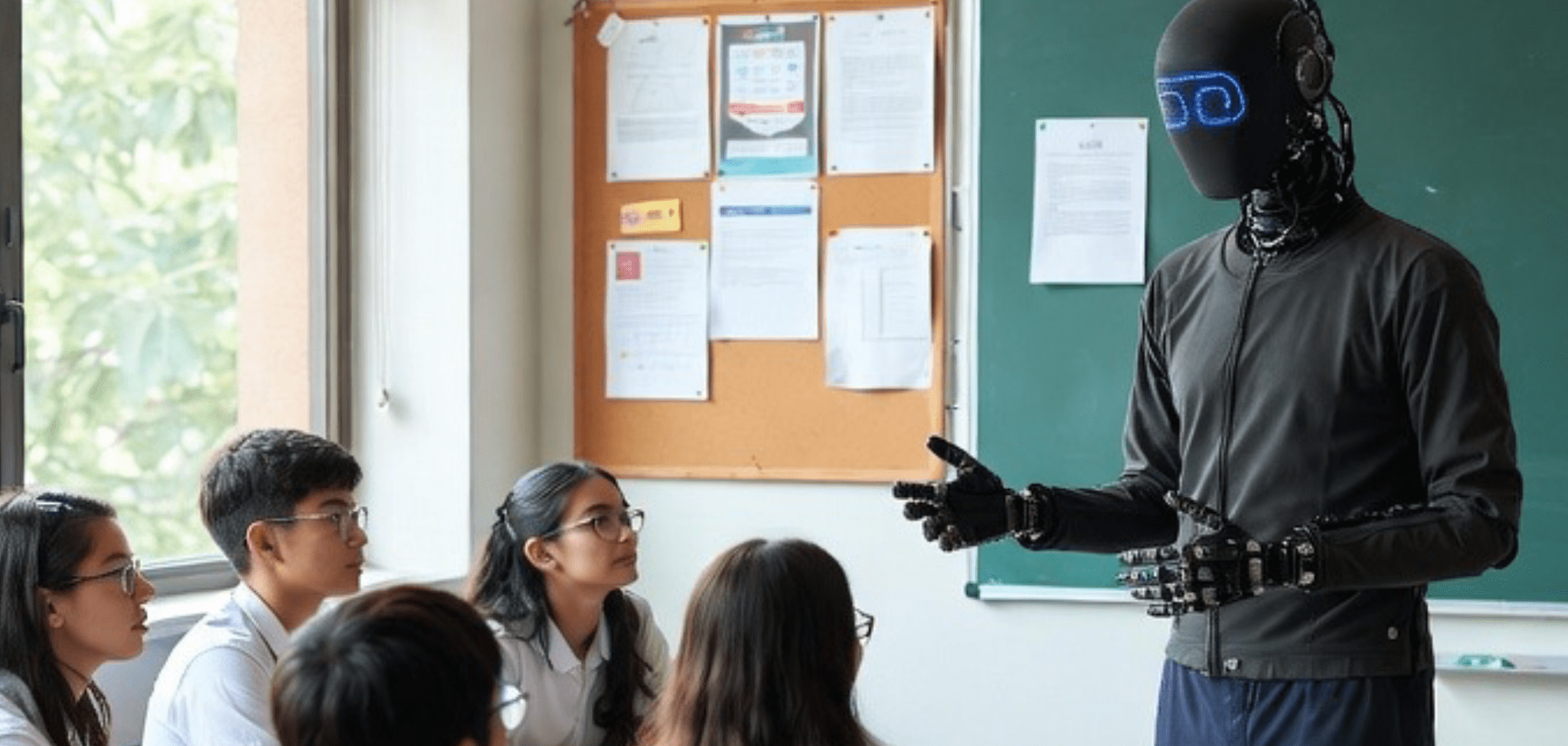
The first Chicago AI school of its kind opens its doors in fall 2026, and the model it’s bringing to Lakeshore East is unlike anything else in the city. Alpha School — a private K–8 network that replaces classroom teachers with adaptive artificial intelligence software — will begin enrolling students at 350 East South Water Street, the former GEMS World Academy building, at a tuition rate of $55,000 per year. The Chicago AI school will be one of roughly 24 Alpha campuses across the country and the highest-profile test yet of whether artificial intelligence can genuinely replace classroom instruction at scale.
This is one of the most controversial education stories of the year — and one of the most quietly important signals about where AI is headed in every industry, not just education. Here’s a complete breakdown of what Alpha actually is, who’s behind it, what its supporters and critics are saying, and what the broader implications mean for any corporate professional watching artificial intelligence transform the white-collar economy.
What the New Chicago AI School Actually Is
Alpha School operates on what its founders call a “two-hour core” model. Students spend just two hours per day on academic instruction — not in front of a teacher, but in front of adaptive AI software that personalizes lessons to each individual student’s pace and skill level. The afternoon is reserved for project-based workshops on topics like public speaking, financial literacy, coding, robotics, and outdoor education. There is no homework. There are no textbooks in the traditional sense.
The school’s human staff are called “guides” rather than teachers. According to founder MacKenzie Price, guides are paid six-figure salaries and are responsible for emotional support, motivation, and workshop facilitation — not academic instruction itself. Critics have pointed out that many of these guides are, in fact, certified educators, making the “no teachers” branding somewhat misleading. But the structural shift is real: at Alpha, the AI does the teaching of core subjects, and the humans handle everything around it.
The Chicago AI school is expected to open with an initial enrollment of approximately 50 to 100 students across Pre-K through 8th grade. It is currently listed as a “candidate for accreditation” with Cognia, the same global accreditation body that has approved Alpha’s existing campuses in Austin, Miami, and Brownsville.
Who Is Behind Alpha and the Chicago AI School Expansion
Alpha School was founded in Austin, Texas in 2014 by MacKenzie Price, a Stanford graduate and educational entrepreneur. She and her husband Andrew Price built the “2 Hour Learning” model from a single Austin location into a national network that now enrolls more than 1,200 students across cities including Austin, New York, Miami, Atlanta, Charlotte, and Raleigh — with the Chicago AI school expansion being one of the most prominent additions.
Price hosts a podcast called Future of Education and maintains a large Instagram presence. The Trump administration has publicly praised Alpha as a possible national model, and First Lady Melania Trump visited the Austin campus as part of an education tour. Education Secretary Linda McMahon has cited the school as an example of what AI-driven education reform could look like nationally.
The political associations have become part of the controversy around the Chicago opening. Pankaj Sharma, secretary-treasurer of the Illinois Federation of Teachers, blasted the new school in pointed terms: “Exorbitant tuition for a school with a MAGA founder, no teachers, no state accreditation, but an AI platform that surveils children and has a track record of harmful outcomes? No thank you.”
The Performance Claims (And the Caveats)
Alpha makes attention-grabbing claims about its results. The school says students rank in the top 1–2% nationally on NWEA MAP standardized tests, learn at 2 to 2.6 times the speed of traditional peers, and graduate with a median SAT score of 1530. In December 2025, Nature — one of the world’s most respected scientific journals — featured Alpha as a possible template for the future of higher education.
The data behind these claims comes almost entirely from Alpha’s own internal assessments. Independent peer-reviewed studies do not yet exist. Critics from the Austin parent community have raised three specific concerns about the data:
First, Alpha’s student body is heavily pre-selected — applicants complete a 5 to 10 hour admissions project, which filters for academically capable and highly motivated students before they ever enroll. Second, students who struggle to keep up with Alpha’s high standards are reportedly asked to leave, further skewing outcomes toward strong performers. Third, the NWEA MAP test — Alpha’s primary performance metric — is arguably gameable by the school’s heavy reliance on multiple-choice practice drills through tools like IXL, rather than measuring deeper conceptual mastery.
In short: the results are real, but the population producing those results is not representative of a typical school’s student body.
The 404 Media Investigation Into the Alpha Model
The most serious independent scrutiny of Alpha’s operations came in February 2026, when investigative journalist Emanuel Maiberg at 404 Media published a deep investigation based on leaked internal documents and interviews with former employees. The findings were significant enough that anyone considering enrolling a child in a Chicago AI school like Alpha should understand them.
The investigation reported:
- Internal Alpha documents acknowledging that the school’s AI sometimes produces poorly constructed, illogical multiple-choice questions that do “more harm than good”
- Allegations that Alpha was scraping lesson content from third-party online courses without permission to train its own AI systems
- Sensitive student data — including videos of children — reportedly stored in an insecure Google Drive folder accessible to anyone with the link, including former employees
- A culture of constant monitoring of students’ mouse movements and screen activity that former staff said was causing student anxiety
Alpha responded by strongly disputing the report, calling the claims “inaccurate and misleading” and reaffirming its commitment to “ethical, research-backed education grounded in the highest standards of data protection.” The school has not, however, released the kind of independent third-party audit that would publicly resolve the questions raised.
What Education Experts Are Saying About the Chicago AI School
The Chicago AI school arrives in a city whose public education system takes a fundamentally different approach to artificial intelligence. Chicago Public Schools uses AI as a supplemental tool within teacher-led classrooms and publishes an AI Guidebook that is updated quarterly. In December 2025, CPS blocked unapproved third-party AI products from its network to comply with FERPA, COPPA, and SOPPA student data privacy requirements. Alpha’s model — where AI is the primary mode of instruction — is the philosophical opposite of CPS’s approach.
Charles Logan, an education researcher at Northwestern University’s Center for Responsible Technology, Policy and Public Dialogue, told Block Club Chicago: “The research on personalized learning and AI learning is mixed at best. I think the Alpha Schools’ approach to adaptive tutoring is like an open experiment and is not supported by critical research.”
An Chih Cheng, an associate professor of education at DePaul University, raised concerns about the foundational reliability of AI instruction: “Those providers are claiming that these allow very instant feedback and adaptive systems to adapt to individual kids’ needs. But the problem, as we all know, AI models still have serious problems. So these teaching materials, they are not necessarily accurate.”
Ebony DeBerry, an elected member of the Chicago Board of Education, has emphasized that human teachers provide emotional support and problem-solving skills that technology cannot replicate. The Chicago Teachers Union has not yet responded publicly to the Alpha announcement.
The Equity Problem at the Heart of the Chicago AI School Model
Perhaps the most fundamental criticism of the Chicago AI school is its price tag. At $55,000 per year — with tuition packages that reportedly include trips to Formula 1 races, Poland, and a summer program in the Hamptons — Alpha is unambiguously a luxury product. Joyce Gerber, an education expert cited in CBS Chicago’s coverage of the launch, put it plainly: “What’s concerning to me is it’s not going to be available to everybody, it’s just not scalable. The cost is just prohibitive.”
At its core, the model concentrates the most powerful personalized AI instruction in the hands of wealthy families, while the AI tools accessible in public schools remain basic and heavily restricted. As one education writer observed, Alpha “hasn’t replaced teachers with AI — they’ve replaced poorer kids and teachers with richer ones.”
DePaul’s Professor Cheng raised the longer-term systemic risk: that widespread AI-driven schooling, if poorly implemented, could degrade public education infrastructure while premium in-person education becomes reserved for the elite — the inverse of today’s model.
Key Facts About the Chicago AI School
| Attribute | Detail |
|---|---|
| School name | Alpha School Chicago |
| Location | 350 E. South Water St., Chicago, IL 60601 (former GEMS World Academy) |
| Grades | Pre-K through 8th grade |
| Opening | Fall 2026 |
| Annual tuition | $55,000 |
| Target enrollment | ~50–100 students initially |
| AI model | 2 hours of adaptive AI academic instruction daily |
| Human staff | “Guides” (not classroom teachers) |
| Accreditation | Cognia candidate (other campuses are accredited) |
| National network size | ~22–24 campuses, 1,200+ students |
| Founder | MacKenzie Price (Stanford alumna, Austin, TX) |
The Bigger Signal: What the Chicago AI School Tells Every Corporate Professional
Here’s the part of this story that most coverage is missing. The Chicago AI school is not just an education story. It’s a labor market story — and for corporate professionals quietly watching artificial intelligence reshape their own industries, it is one of the most important signals of the year.
Consider what is actually happening at Alpha. A function that has employed millions of people in the United States for over a century — classroom instruction — is being substantially replaced by software. The people who remain in the building are not teachers in the traditional sense. They are facilitators, motivators, and emotional supports. The actual cognitive work of teaching a 4th grader fractions has been delegated to an AI system that costs a fraction of what a human salary would.
If you are a corporate professional currently earning a six-figure salary, take a hard look at that pattern. The same model is now being applied to:
- Customer service teams across every industry
- Front desk receptionists at medical practices, dental offices, and law firms
- Lead qualification specialists at home services companies
- Inbound sales development reps
- Bookkeeping and accounts payable clerks
- Paralegal research roles
- Junior analyst work in financial services
- First-line technical support
- Content production, copywriting, and basic creative work
Alpha is doing it for fourth graders learning math. The same playbook is being run on roles that pay $50,000 to $250,000 per year. The only meaningful difference is the politeness of the messaging.
McKinsey reports that 92% of companies have no clear artificial intelligence strategy and only 3% currently offer AI implementation services. Goldman Sachs surveyed 1,256 small business owners in March 2026 and found that 76% are already using AI, but only 14% have embedded it into core operations. The gap between the businesses that need AI deployed properly and the operators who know how to deploy it is the largest single market opportunity of the decade — and it is the same gap that lets a Chicago AI school charge $55,000 a year for software-driven instruction while public schools restrict AI use to supplemental tasks.
A salary has a ceiling. Inflation doesn’t.
I graduated from Vanderbilt. Almost went straight into investment banking. I spent years at Vanderbilt University reading the same labor reports and McKinsey decks that economists and consultants have been reading — and I came away with one inescapable conclusion: the people who quietly build positions on the implementation side of this AI wave will compound for the next decade, while the people who stay on the salary side will increasingly find themselves on the wrong end of the same automation playbook Alpha is running on teachers.
I decided not to try and outrun inflation with a salary. I replaced my corporate salary by implementing pre-built AI tools we leverage — Intercom AI, Helios AI, and n8n — for local service businesses that need them and don’t know how to install them themselves.
There are roughly 36 million small businesses in the United States. Most of them are missing 20–40% of their inbound calls, leaking $50,000 to $500,000 per year in lost revenue, and have no idea how to deploy the same kinds of AI systems that are now running classrooms in Chicago. Operators who pick one industry, learn three tools, and start signing local clients are building $1,500 to $3,000 per month per client in recurring revenue. Three to five clients equal a full-time corporate-equivalent income working a few hours a week.
While 99% of people wait for the “right time,” smart operators are locking in clients now — and the Chicago AI school opening this fall is one more piece of evidence that the right time was about two years ago.
The Bottom Line on the Chicago AI School
Alpha School Chicago is a genuinely unprecedented experiment in American education — a $55,000 per year boarding-school-style AI campus in one of the country’s most economically segmented cities. The performance claims are bold. The data behind them is internal. The 404 Media investigation raised serious concerns about AI quality, data privacy, and student surveillance that Alpha has disputed but not fully resolved.
For Chicago parents, the school presents an enormous decision with limited independent evidence to evaluate it. For Chicago educators and public school families, it raises hard questions about whether AI in education will widen or narrow the opportunity gap.
For everyone else watching — and especially for corporate professionals quietly weighing whether their own industries are next — the Chicago AI school is a signal worth reading carefully. The same forces that let one Stanford alumna build a 24-campus network charging top-of-market tuition for software-delivered instruction are the forces reshaping every white-collar job category in America right now.
The fall 2026 launch will be closely watched. So should the broader pattern it represents.