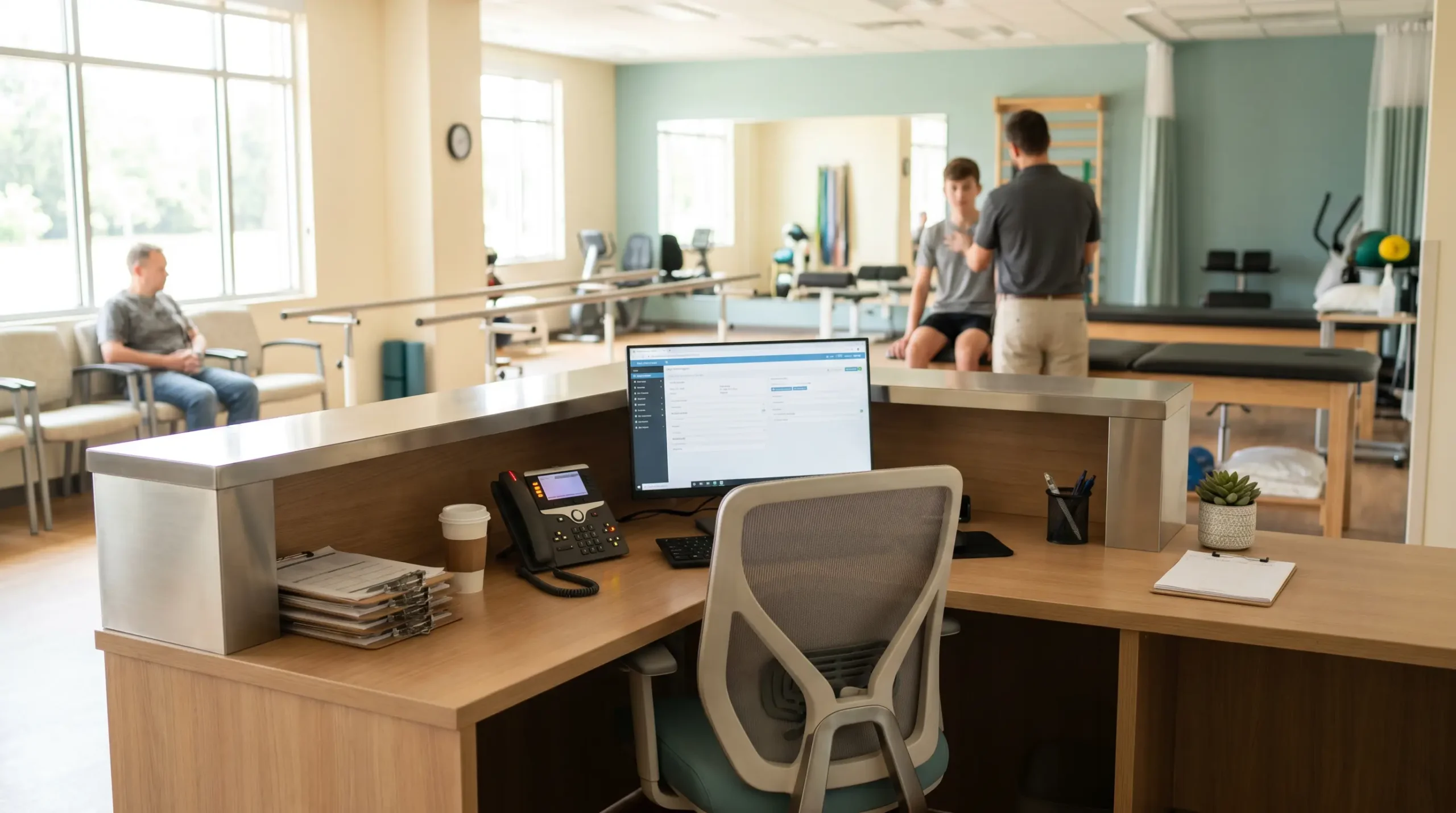
AI for physical therapy clinics has become the single most overlooked operational investment in outpatient rehab — and most PT clinic owners have no idea that the two biggest revenue leaks their business has are now solvable by the same deployable system. A typical PT clinic receives 50–80 inbound calls per day. Industry research from medical practice management studies shows healthcare practices miss 20–30% of those calls during business hours. After hours, the miss rate climbs to nearly 100% — and 41% of all healthcare calls come outside standard 9-to-5 windows.
But missed calls are only the first leak. The bigger problem is the one that hits after a patient has actually been booked: industry data shows that 50% or more of physical therapy patients drop out of their care plan before completing the recommended number of visits. That’s a patient who was acquired, evaluated, accepted into care, and then quit — usually for reasons that have nothing to do with treatment quality and everything to do with communication, friction, and life getting in the way.
Stack those two leaks together — the inbound call leak and the patient drop-off leak — and you arrive at the actual financial pain of running a PT clinic in 2026. You’re losing tens of thousands of dollars per month at the front door, and you’re losing tens of thousands more out the back door from incomplete care plans. The good news: both leaks are solvable now in a way they weren’t even 18 months ago. And the solution doesn’t require hiring more staff in a labor market where there isn’t anyone left to hire.
Why PT Clinics Are Uniquely Exposed to Both Leaks
The physical therapy business sits at an unusual intersection of operational pressures.
1. Insurance + cash-pay scheduling is the most complex front-desk workload in healthcare. Your front desk has to verify benefits, confirm visit caps, get prior auths, navigate ICD-10 codes, schedule across multiple therapists with different specializations, and handle cash-pay patients with completely different workflows. All while answering the phone. There is no realistic way to staff for it.
2. PT requires repeat visits — and every dropped visit compounds the leak. Unlike a one-time procedure, a PT episode of care is typically 8–24 visits over 4–12 weeks. Every missed appointment cascades: a no-show on visit 4 often means the patient quits entirely by visit 6. Industry data shows the average patient who drops out leaves $1,500–$4,000 in unrealized care plan revenue on the table per episode.
3. Referral-driven, but referrals aren’t enough anymore. Most PT clinics still rely heavily on physician referrals. But industry research shows direct-access patients (those who call without a referral) now make up a growing share of new patients — and these are the patients most likely to call multiple clinics in one afternoon and book with whoever answers first.
4. After-hours calls are essentially all lost. A patient calling at 7 PM after their primary care doctor said “you should see a physical therapist” is the highest-intent caller you’ll get all month. Without an AI or live-answer system, that call goes to voicemail and the patient books with the clinic that does answer.
5. The reactivation list is sitting on a goldmine nobody touches. Most PT clinics have hundreds or thousands of former patients in their EMR who completed a previous episode of care 12+ months ago. Many of those patients have flared up again, or have new issues, and would book a fresh evaluation if asked. Almost no clinic systematically asks.
The clinics winning in PT in 2026 aren’t necessarily the ones with the best clinicians. They’re the ones whose phones get answered, whose patients complete their care plans, and whose former patients get systematically reactivated.
What AI for Physical Therapy Clinics Actually Means in 2026
A proper deployment of AI for physical therapy clinics addresses five distinct workflows. This is not “a chatbot on your website.” It is an integrated operational system that runs alongside the clinic.
1. 24/7 AI Voice Reception
The highest-leverage use case in any PT clinic. An AI voice agent answers inbound calls instantly — no rings to voicemail, no hold time. It handles routine inquiries (services, hours, insurance accepted, what to expect at evaluation), books evaluations directly into your scheduling system, captures the caller’s injury area and referring physician, and operates 24 hours a day.
This single workflow captures the after-hours calls that currently go entirely to voicemail and the lunch/peak overflow that the front desk physically can’t cover.
2. Insurance Verification Pre-Work for PT Practices
A PT-specific workflow that’s quietly enormous. AI for physical therapy clinics can handle a significant portion of the eligibility check work — confirming insurance is active, checking visit limits, flagging when a prior auth is needed, and pre-populating the data your billing team or front desk would otherwise have to chase manually. This isn’t replacing your verification specialist. It’s eliminating the most repetitive 60–70% of their work so they can focus on the complex cases.
3. Attendance and Drop-Off Prevention
The most underrated workflow for PT specifically. AI handles automated multi-channel reminders 24 hours before each appointment, post-visit check-ins (“How are you feeling after yesterday’s session?”), and proactive outreach if a patient misses or reschedules. Industry data shows clinics that maintain consistent between-visit communication see substantially higher care plan completion rates than clinics that don’t.
The math here is striking: even moving completion from 50% to 65% on a typical 12-visit plan adds roughly $360–$720 per patient. For a clinic seeing 200 new patients per year, that’s $72,000–$144,000 in recovered revenue per year, with no additional acquisition cost.
4. Missed Call Text-Back and Speed-to-Lead
If a call slips through, an automated text fires within seconds: “Hi — this is [Clinic]. We missed your call. What’s the injury and when did it start? I can text you available evaluation times right now.” Harvard Business Review research shows responding to web leads within 5 minutes increases conversion by up to 400% compared to slower response. AI makes that response time achievable 24/7.
5. Former Patient Reactivation
The dormant-patient goldmine. AI runs systematic outbound reactivation outreach to patients who completed an episode of care 6–18 months ago, asking how they’re feeling and offering reactivation evaluations. Industry data shows reactivating a former patient costs roughly $12 compared to $312 for a new patient — and former patients book at much higher conversion rates because the trust is already built.
Deployed correctly, the typical PT clinic moves from 30% missed calls to under 5%, lifts care plan completion by 10–20 percentage points, and recovers a dormant patient base most clinics were leaving completely unmonetized.
What AI for Physical Therapy Clinics Actually Costs in 2026
For PT clinic owners evaluating the investment:
Tool-only AI receptionist platforms: $199–$599/month. Real tools, but sold as software not solutions. Most clinics that self-deploy see degraded performance within 60 days.
Managed AI implementation for a single-location PT clinic: $1,500–$3,000/month plus a one-time setup fee. This covers voice reception, attendance automation, insurance verification pre-work, missed-call text-back, reactivation campaigns, integration with your EMR (WebPT, Prompt, Heno, Clinicient, etc.), and ongoing monthly management.
Multi-location PT groups: $3,000–$10,000/month for managed deployment across 3–10 clinics with centralized KPI tracking.
Compare those numbers to:
- Hiring an additional front desk coordinator: $4,000–$6,000/month all-in
- Continuing to miss 25–30% of inbound calls
- Continuing to lose 50%+ of patients to early drop-off
- Continuing to leave dormant former patients completely uncontacted
The math closes in the first conversation. For a clinic doing $1M+ in annual revenue, AI for physical therapy clinics typically pays for itself in the first 45 days from captured calls and reduced drop-off alone — before counting reactivation revenue.
Why AI for Physical Therapy Clinics Is One of the Best Implementation Niches for 2026
For corporate professionals reading this and evaluating whether to build an AI implementation business serving PT clinics — here’s the honest read.
PT is arguably one of the strongest target niches available right now. The reasons:
- The industry is expanding rapidly. Direct access laws have opened in nearly every state. The PT industry is consolidating into larger groups. New cash-pay practices are launching constantly. All of them need front-desk infrastructure they don’t have time to build.
- The pain is universal and compounding. Missed calls + drop-off + dormant lists — every PT clinic has all three problems, and the ROI math is easy to demonstrate in a 15-minute audit.
- Multi-location operators scale your contract. A single-clinic relationship can grow into a 10-clinic relationship as a PT group expands or gets acquired by a larger platform.
- Owners control the budget. Solo and small-group PT clinics have a clinician owner who can decide on the call.
- The recurring revenue economics are strong. $1,500–$3,000/month per single-location client. 3–5 clients = a full-time corporate-equivalent income working a few hours a week.
I graduated from Vanderbilt. Almost went straight into investment banking. I spent years at Vanderbilt University reading reports about where the economy was headed and decided early on that a salary has a ceiling, inflation doesn’t. I decided not to try and outrun inflation with a salary. I replaced my corporate salary by implementing pre-built AI tools we leverage — Intercom AI, Helios AI, and n8n — for local healthcare practices with exactly this operational gap.
According to McKinsey, 92% of companies have no clear AI strategy and only 3% offer AI implementation services. PT is one of the most underserved sub-niches within that gap. While 99% of people wait for the “right time,” smart operators are locking in PT clients now — and clinic owners who see the math on their drop-off rate and dormant patient list typically sign within one conversation.
What to Look for When Choosing an AI for Physical Therapy Clinics Implementation Partner
For PT clinic owners evaluating their options:
- Healthcare specialization matters. A specialist who has deployed in PT and rehab clinics understands insurance verification flows, prior auth workflows, and the difference between an evaluation and a follow-up visit. A generalist will miss those nuances.
- EMR integration is non-negotiable. WebPT, Prompt, Heno, Clinicient, Raintree, Casamba — your AI needs to talk to whatever you use.
- Ask about completion rate and reactivation outcomes, not just call answering. “We answered 47 after-hours calls” is incomplete. “We answered 47 after-hours calls worth $X in evaluations, lifted plan completion from 52% to 64%, and reactivated 38 former patients in the first 90 days” is the right report.
- Avoid setup-only deployments. Recurring management is the entire reason your AI keeps performing.
- Confirm HIPAA-aware deployment. Business Associate Agreements signed with your clinic, encryption in transit and at rest, and audit logging on every interaction.
The Bottom Line on AI for Physical Therapy Clinics
PT clinics are not losing patients because the therapy is bad. They’re losing patients at the front door because the phone goes to voicemail, in the middle of care because nobody followed up after visit 3, and in the back office because the dormant patient list is just sitting in the EMR.
AI for physical therapy clinics fixes all three. At a cost that’s a fraction of what most clinics already spend on marketing.
The clinics that deploy now will compound — larger active rosters, higher completion rates, and reactivation revenue their competitors will never see.
The phone is going to keep ringing. The only question is whether something answers — and whether the patients you’ve already paid to acquire actually complete the care plans they signed up for.