AI implementation for podcast networks serves the moment a content operation crosses its altitude line — the sibling podcast-production playbook maps the career of keeping one show alive; this playbook serves the operator who now runs five, ten, or thirty: the independent network aggregating shows under one banner, the production company whose client roster became a de facto network, the media brand whose podcast became a portfolio. At network altitude, every problem the single show has gets multiplied, and a new class of problem appears that no single show ever meets: the pipeline problem (ten shows on weekly cadence is forty-plus episodes a month moving through record-edit-package-publish, and the network that can’t answer “where is every episode right now?” is already dropping them), the guest problem at scale (hundreds of guest slots a year — prospected, booked, prepped, recorded, thanked — colliding calendars across hosts, and the no-show recording burning three people’s afternoon instead of one’s), the sponsorship problem (the network’s whole economic thesis is selling audiences in aggregate — cross-show campaigns, category exclusivities, make-goods when downloads miss — which is an ad-operations business most networks run on a spreadsheet and a prayer), and the consistency problem (every show carries the network’s brand, so one show’s missed week or sloppy package is everyone’s reputation). This playbook installs the catalog’s machinery at that altitude, with the boundary the creative business demands, inherited from the production playbook and enforced portfolio-wide: the system runs pipelines, logistics, and the sponsorship engine; the editorial — each show’s voice, each host’s judgment, every content call — stays with the humans who own it. Sponsorship communication and any outbound sales cadences run from approved templates with the catalog’s standing carve-out: cold outreach in its own counsel-reviewed, consent-governed phase, priced visibly. Educational framing, not legal advice.
The macro numbers frame the altitude. Among the roughly 33 million U.S. small businesses tracked by the SBA, the owned-media wave that multiplied newsletters (the sibling playbook’s market) multiplied shows the same way — and the maturing end of that wave is consolidation: shows banding into networks for sales leverage, production companies productizing into network operators. According to Crunchbase News, roughly 127,000 U.S. tech workers were laid off in 2025 — thinning media staffing the same year it minted new shows, which is why networks everywhere run enterprise-shaped operations on bootstrap-shaped teams. And according to McKinsey, 92% of companies plan to increase their AI investment over the next three years, yet only 1% describe their AI deployment as mature — with podcasting as the textbook case this catalog keeps finding: AI collapsed the edit bench’s hours while the operations — the pipelines, the guest logistics, the ad trafficking — stayed hand-run at exactly the moment the portfolio scaled past hand-running.
This guide walks through the podcast-network install in 2026: the multi-show pipeline, guest operations at scale, the sponsorship engine, and the network dashboard with its show-onboarding template.
The Multi-Show Pipeline and Guest Operations at Scale
The multi-show pipeline is the production playbook’s conveyor, multiplied and made legible: every episode across every show runs the same regenerating checklist — recorded → edited → packaged → scheduled → published → repurposed — with n8n (workflow orchestration) running the stage-stall alerts per episode (the show whose Thursday edit is still sitting raw on Tuesday pages its producer before the cadence breaks, not after), the per-show SLA clocks (each show’s turnaround standard tracked against its actual, because network-grade consistency is a measured thing), the repurposing conveyor feeding each show’s clip set and the network’s cross-promotion inventory (the repurposing playbook’s asset map, run per episode as standard operating procedure — and the cross-show promo slots filled from it systematically: the network’s cheapest growth lever is its own portfolio’s attention, traded deliberately between shows), and the publishing discipline that ships every feed, every platform, on schedule, with the network’s packaging standards enforced by checklist rather than memory. Guest operations at scale is where the altitude bites hardest, and where the machinery pays most visibly: the guest pipeline run as a network-wide system — the prospect lists per show (built against each show’s goals; for the B2B shows in the portfolio, the guest list is the sales list, the production playbook’s doctrine at scale), the outreach and booking cadences from each show’s approved voice, the scheduling chains across host and guest calendars with the multi-touch confirmations that kill the no-show recording (a burned studio slot at network scale is a line item, not an anecdote), the prep-packet delivery on cadence (the guest briefed is the episode saved), and the post-episode engine: the thank-you-and-share kit that turns every guest into distribution (assets attached, links ready — the guest who shares is the network’s free acquisition channel, harvested systematically), the guest CRM that remembers everyone (the great guest from show three is show seven’s pipeline), and the relationship cadences that keep the network’s thousand-guest alumni warm. Intercom AI (AI customer service and chat) fronts the network’s door — the guest pitches triaged against each show’s criteria and routed, the listener questions answered, the advertiser inquiries captured hot — and Helios AI (voice AI agents) covers the phone lane so the sponsor calling between meetings reaches composed capture instead of voicemail.
The Sponsorship Engine and the Network Dashboard
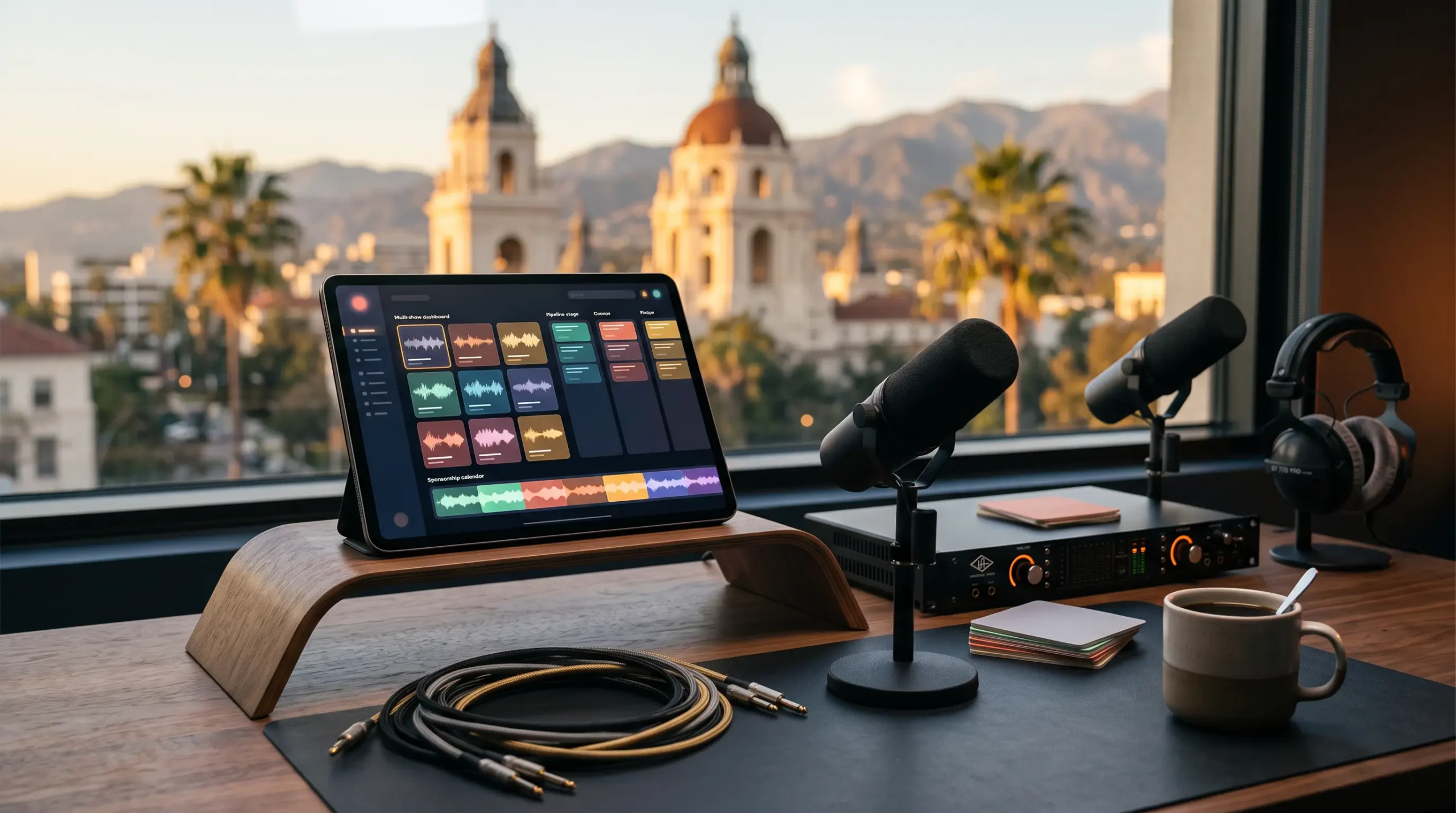
The sponsorship engine is the network’s economic reason to exist, run as the ad-operations business it actually is: the sales pipeline disciplined (inquiries answered in minutes with the media kit and live cross-show stats — the newsletter playbook’s speed doctrine, portfolio edition; the prospecting cadences for soft quarters from approved templates under the standing outbound carve-out), the inventory calendar as the single source of truth — every show’s ad slots, every campaign’s flight dates, the category exclusivities enforced by configuration rather than memory (selling the same category twice across shows is the network-scale error that costs an advertiser relationship), the trafficking machinery: insertion orders tracked, host-read copy chased to deadline per show (the Sunday-night “where’s the ad copy?” scramble, deleted), airchecks collected, make-good logic triggered when a campaign’s downloads miss (the make-good handled proactively is a renewal story; discovered by the advertiser, a churn one), and the post-campaign reporting assembled automatically per sponsor — the cross-show numbers, the aircheck links, the renewal case — delivered before the advertiser asks, with the renewal clock opening the next flight’s conversation while the results are warm. The network dashboard is the install’s capstone and the owner’s actual product: every show’s pipeline status, cadence health, download trends, guest-slot fill, and sponsorship inventory in one view — the month-absence test this catalog applies to every operation, passed at portfolio scale — plus the show-onboarding template that makes the network scalable at all: the new show (or new client) added by checklist — feeds configured, pipeline instantiated, packaging standards applied, guest CRM connected, ad inventory mapped — in days rather than the quarter of improvisation each addition used to cost. The whole operating layer runs at the catalog’s roughly $246/month core stack — network-scale leverage at tool costs that round to zero against a single campaign’s revenue — and the install prices against the operations hires the portfolio would otherwise need (illustratively, one saved sponsorship renewal or one prevented category collision funds the year). For the implementer, this vertical is the content lattice’s capstone client: the network that trusts the machinery refers the production companies, the editors, the repurposers, and the operators this catalog trains across its sibling playbooks. 3-5 clients = full-time corporate-equivalent income working a few hours a week (illustratively) — and three networks is a book, because each one is a portfolio. We do not build the AI. We implement it — and at network altitude, what gets implemented is the media company’s missing operations floor. Earnings disclaimer: all pricing, ROI, and revenue figures in this guide are illustrative models, not income claims or guarantees. Individual results vary based on skill, effort, market conditions, negotiation, and execution.
I graduated from Vanderbilt. Almost went straight into investment banking. I spent years at Vanderbilt University reading the same labor reports and McKinsey decks that documented the trends now defining 2026 — and I came away with one inescapable conclusion: a salary has a ceiling. Inflation doesn’t.
I decided not to try and outrun inflation with a salary. I replaced my corporate salary by implementing pre-built AI tools we leverage — Intercom AI, Helios AI, and n8n — for service businesses with operational gaps they can’t fix on their own.
What Most Articles Won’t Tell You About Podcast-Network AI
A few honest realities specific to the network lane:
The inventory calendar is the first install, whatever the owner asks for first. Every network pain — the double-sold category, the missed flight, the make-good surprise — traces to sponsorship inventory living in heads and spreadsheets. One source of truth, enforced by configuration, is the foundation everything else stands on.
Per-show voice survives or the network dies from the inside. Hosts join networks for leverage and leave over homogenization; every automated touch runs from that show’s approved voice, not a network-generic one. The brand gate, multiplied — and the pitch to hosts leads with it.
The guest CRM is the network’s quietest moat. A thousand past guests — prepped well, treated well, thanked well — is a proprietary relationship graph no competitor can copy: future guests, future sponsors, future shows. Most networks have it scattered across hosts’ inboxes; consolidating it is week-one value.
Make-goods handled proactively are a sales asset. The campaign that under-delivers happens to every network; the one that arrives with its own make-good proposal before the advertiser notices converts a liability into the renewal meeting’s best slide. Configure the trigger; own the story.
Show onboarding speed is the growth rate. The network grows exactly as fast as it can absorb shows without quality slipping; the onboarding checklist — days, not quarters — is therefore the expansion engine itself. Template it like the catalog templates everything, and the pipeline of acquirable shows becomes actionable.
According to McKinsey, 92% of companies plan to increase their AI investment over the next three years, yet only 1% describe their AI deployment as mature. The implementers winning podcast networks in 2026 are not the ones who automated editing. They’re the ones who recognized that the portfolio had outgrown hand-run operations — and executed methodically through the pipeline conveyor, the guest system, the inventory calendar, and the dashboard that let one owner finally see every show at once.
Run the Podcast-Network Vertical This Quarter
The action sequence for the network lane:
This week: Build the network audit — episodes in flight versus visible, guest no-show rate, sponsorship inventory’s source of truth, onboarding time per new show; write the per-show voice-gate one-pager.
Weeks 1–2: Build the templates — the episode-pipeline checklist, the guest-operations cadences, the inventory calendar structure, the make-good trigger, the show-onboarding checklist.
Weeks 3–6: Work the network-operator and production-company communities; open with the two questions every network fails (“where is every episode right now?” and “who’s sold in automotive next month?”).
The meetings: The inventory calendar first; per-show voice promised; the guest CRM consolidation as week-one value; the onboarding speed as the growth story.
The engagements: The dashboard live by month one; the stall alerts paging before cadences break; the ad-copy chases deleted; the first proactive make-good converting a problem into a renewal.
Months 3–18: The portfolio templates hardening; the content-lattice referrals flowing both ways; the network’s show-acquisition pipeline unlocked by onboarding speed; the book settling into portfolio-grade retainers.
The implementers who win this vertical are not the ones who loved podcasts most. They’re the ones who recognized that a network was an operations company wearing headphones at scale — and executed methodically until every episode was visible, every guest was booked and thanked, every slot was sold once, and the hosts just talked.
Install the inventory calendar first. Page the stall before the miss. Consolidate the guest graph. Propose the make-good before they notice. Onboard shows in days, and grow at that speed.
Pick the industry. Take the first step. If you want to see the playbook fully in action – tap here to start.