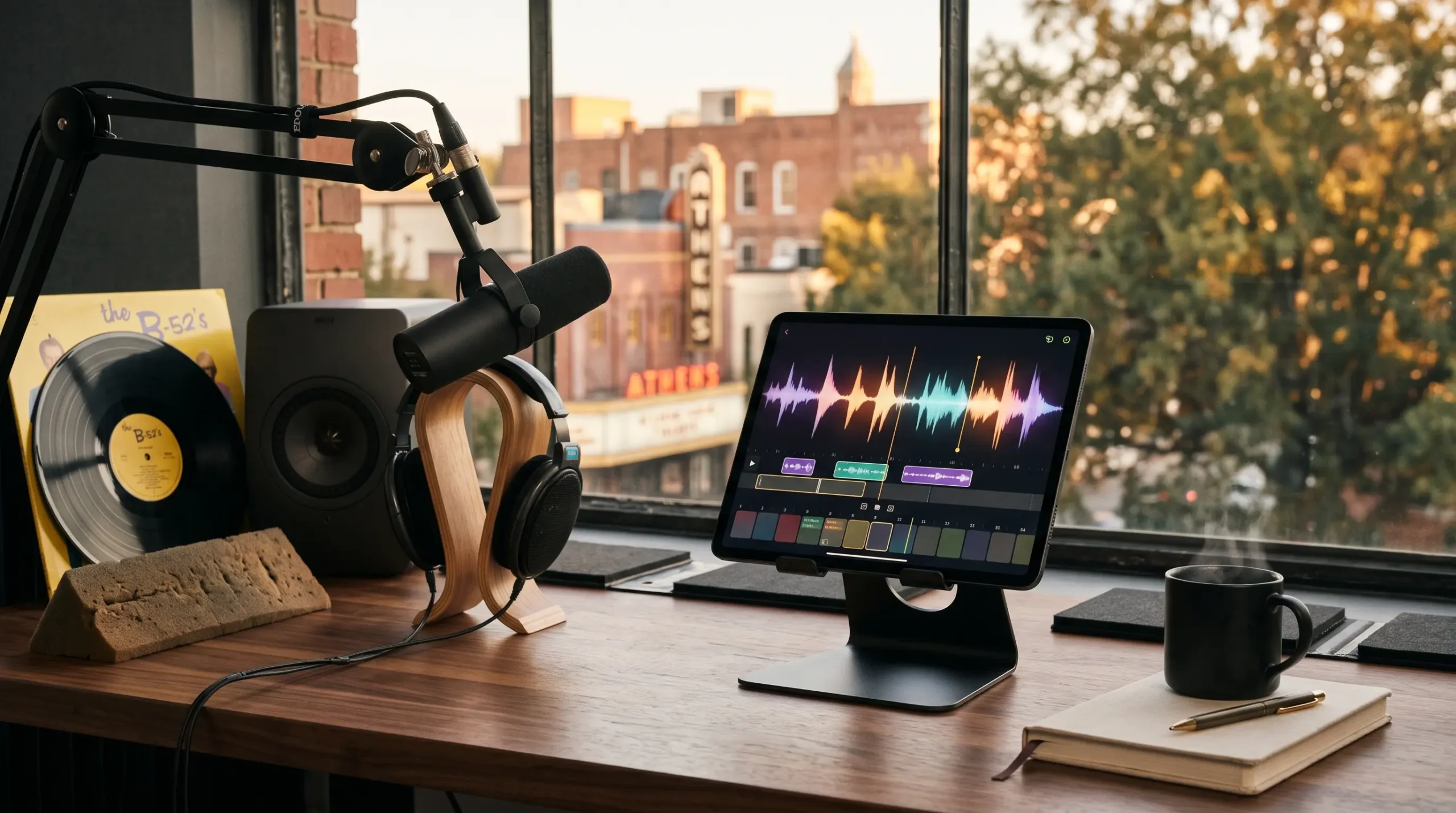
Podcast production is the creative career clients can’t hire fast enough — and the demand has a precise anatomy worth stating before the romance does: the shows that pay for production aren’t trying to be hits; they’re trying to be consistent. The 2027 podcast economy’s center of gravity has shifted from the entertainment chart-chasers to the professional operators — the B2B company running a show as its relationship engine (every guest is a prospect or partner who just spent an hour with the founder), the consultant and coach whose episodes are their authority proof (the coaches-and-consultants playbook’s buyers, holding microphones), the firm using a show as its content refinery (one conversation becoming a month of clips, posts, and newsletter material) — and for all of them the business case lives or dies on cadence: the show that ships every week compounds; the one that “took a break in March” quietly died, as most do. That mortality is the market. Podcasting’s graveyard is filled by production burden, not by lack of ideas — the recording that needs editing, the notes that need writing, the clips that need cutting, the guest who needs booking, prepping, and thanking, the publishing checklist across platforms — and the producer who takes all of it sells the only thing that keeps shows alive: the machine that makes next week’s episode inevitable. This playbook maps the career with the catalog’s standing honesty: the full production anatomy and where the money concentrates (hint: not in editing), the AI question answered straight, the retainer geometry, and the entry path — including the honest warning about the commodity basement this career must price itself out of.
The macro numbers frame the professional turn. Among the roughly 33 million U.S. small businesses tracked by the SBA, the share investing in owned media keeps climbing as rented channels get costlier — the same owned-audience logic the email playbook runs, with a voice. According to Crunchbase News, roughly 127,000 U.S. tech workers were laid off in 2025 — a wave that minted new consultancies and personal brands, each needing an authority engine, and supplied the market’s producers: the project managers and content professionals whose skills map cleanly onto production operations. And according to McKinsey, 92% of companies plan to increase their AI investment over the next three years, yet only 1% describe their AI deployment as mature — with podcasting as a vivid case: AI editing tools everywhere, while the system around the show — the calendar, the guest pipeline, the repurposing engine, the publishing discipline — remains the part nobody built, and the part this career actually sells.
This guide walks through podcast production in 2027: the full anatomy and where the money sits, the AI question, the retainer model, and the entry path past the commodity basement.
The Full Production Anatomy — and Where the Money Actually Sits
The anatomy runs in four layers, and the money climbs with them. The edit layer is the floor: audio cleaned, filler trimmed, levels mastered, the episode assembled — necessary craft, and the career’s commodity basement, because editing alone competes globally on price and AI tooling keeps compressing it (the honest version of this career never leads with editing). The package layer adds the publishing deliverables: show notes written to serve search and the listener, titles that earn the click honestly, the episode art and audiograms, the publishing checklist executed across platforms on schedule — this is where consistency becomes visible, and where the producer’s judgment (what the episode was about, what moment carries the clip) starts separating from the software. The repurposing layer is where the professional shows earn their budget: one recorded hour refined into the month’s content — the clip set cut to each platform’s grammar, the quote graphics, the newsletter section, the article draft from the transcript — the content-refinery math that makes a show the most efficient content investment a firm owns, when someone runs the refinery on cadence. The show-running layer is the top and the real career: the guest pipeline operated end to end (prospecting against the show’s goals — which for B2B shows is the client-development list wearing headphones — the outreach, the booking, the prep packets, the day-of logistics, the thank-you-and-share kit that turns every guest into a distributor), the content calendar that survives the host’s busy season, the recording logistics, and the metrics rhythm (downloads, completion, the clips’ reach, and — for the professional shows — the relationships and pipeline the show actually produced, reported in the client’s own terms). The producer who sells layers three and four isn’t competing with cheap editing; they’re running the client’s authority engine — and that’s the service clients can’t hire fast enough, because it requires the operations discipline this catalog teaches everywhere, applied to a creative product.
The AI Question, the Retainer Geometry, and the Entry Path
The AI question gets the catalog’s straight answer: the tools genuinely compressed the edit layer — transcription is instant, filler-cutting is automated, mastering is one pass — and that compression is the career’s gift, not its threat, because it collapsed the hours in the layer that never paid well and freed them for the layers that do. What AI doesn’t own is the judgment stack: which forty seconds carries the clip, what the episode’s real headline was, which guest serves the show’s strategy, whether this week’s conversation quietly embarrassed the brand — the producer’s taste and the client’s trust, which is the actual product. The operator’s machinery runs the system around the craft: n8n (workflow orchestration) running the episode pipeline as a regenerating checklist (recorded → edited → packaged → scheduled → published → repurposed, with stall alerts when any episode ages in a stage — the PM doctrine this catalog teaches, pointed at a feed), the guest-pipeline cadences (the outreach sequences, the booking confirmations that kill the no-show recording, the prep-packet delivery, the post-episode share kits), and the publishing and metrics rhythm; Intercom AI (AI customer service and chat) catching the show’s inbound — the guest pitches, the listener questions, the sponsorship inquiries — answered from approved content and routed; Helios AI (voice AI agents) covering the production company’s own line as it grows. The roughly $246/month core stack under per-show retainers is the margin structure, and the retainer geometry prices by layer: edit-and-package as the entry tier, repurposing as the growth tier, full show-running as the premium — monthly, per show, priced against the content budget the refinery replaces and the consistency the client cannot sustain alone (illustratively, the full-service tier prices like a fraction of the content hire the show would otherwise require). 3-5 clients = full-time corporate-equivalent income working a few hours a week (illustratively) — with the honest note that layer-four shows are involved relationships, so the band mixes tiers: a couple of full-service shows anchored by edit-and-package accounts the machinery makes nearly passive. The entry path: produce one show end to end as the portfolio (your own, or a local firm’s rescued from its own graveyard — the relaunch story is this career’s best proof), template the pipeline deliverables, pick the lane (B2B relationship shows, expert-authority shows, and internal/branded shows are different products), and sell through the niches this catalog already maps — the coaches, consultants, and firms whose playbooks all end with “build authority” and who stall at exactly the production burden this career absorbs. Learn a skill instead of buying into a business model — and this one comes with a microphone and a deadline that never stops teaching. Earnings disclaimer: all pricing, ROI, and revenue figures in this guide are illustrative models, not income claims or guarantees. Individual results vary based on skill, effort, market conditions, negotiation, and execution.
I graduated from Vanderbilt. Almost went straight into investment banking. I spent years at Vanderbilt University reading the same labor reports and McKinsey decks that documented the trends now defining 2027 — and I came away with one inescapable conclusion: a salary has a ceiling. Inflation doesn’t.
I decided not to try and outrun inflation with a salary. I replaced my corporate salary by implementing pre-built AI tools we leverage — Intercom AI, Helios AI, and n8n — for service businesses with operational gaps they can’t fix on their own.
What Most Articles Won’t Tell You About Podcast Production
A few honest realities specific to the audio lane:
Never sell edits; sell the show staying alive. The client who shops for editing compares you to a global price floor; the one who buys cadence, repurposing, and guest operations compares you to hiring a content team. Position at the system layer from the first conversation — the podcast graveyard statistic is your opening slide.
The B2B relationship show is the lane where budgets live. Entertainment shows monetize audiences they mostly don’t have; B2B shows monetize guests — the founder’s hour with a dream prospect — which means the show pays for itself in pipeline before download numbers matter. Producers who understand that math charge accordingly and report relationships, not just downloads.
Consistency is your deliverable, so your own operations are the audition. The producer who misses their own publishing deadline has refuted their pitch. The pipeline checklist, the buffer episodes, the recording cadence that survives the host’s travel — run your shop like the catalog runs everything, because the client is watching the meta-lesson.
The host’s voice is the brand gate at its most audible. Show notes, titles, and clips all speak as the show; everything templated gets blessed in the host’s voice, and the guest-facing communication doubly so — a guest’s experience of the show’s operations is the brand to the exact audience the show exists to impress.
Rescues beat launches for building the book. The market is full of podfaded shows with eleven episodes and a guilty owner; the relaunch engagement — audit what died, rebuild the pipeline, ship eight straight weeks — is faster to sell than a launch and produces the before/after story that sells the next one.
According to McKinsey, 92% of companies plan to increase their AI investment over the next three years, yet only 1% describe their AI deployment as mature. The producers winning this career in 2027 are not the ones with the best editing chops. They’re the ones who recognized that shows die of operations, not of content — and executed methodically through the pipeline, the guest engine, and the repurposing refinery that made every client’s next episode inevitable.
Run the Podcast-Production Career This Quarter
The action sequence for the audio lane:
This week: Produce or adopt the portfolio show; build the episode-pipeline checklist and the guest-cadence templates; pick the lane (B2B relationship shows recommended).
Weeks 1–2: Template the four-layer deliverables and the tiered pricing; master the AI edit stack so the floor costs you minutes, not evenings.
Weeks 3–6: Hunt the graveyard — the local firms and consultants with podfaded shows; offer the relaunch audit; ship the first eight-week rescue.
The meetings: The graveyard math first; layers, not edits; pipeline reported in relationships for B2B shows; the host’s voice gate promised.
The engagements: Buffer episodes banked before launch; the pipeline checklist running; the share kits turning every guest into distribution; the monthly report in the client’s own terms.
Months 3–18: The relaunch stories compounding; the tier mix balancing the book; the repurposing refinery feeding the clients’ other channels — and referrals from every guest who was treated like the show’s most important one.
The producers who win this career are not the ones who loved the sound of their own show. They’re the ones who recognized that every client’s podcast was an operations problem wearing headphones — and executed methodically until the episodes shipped every week, the guests became pipeline, and the hosts just talked.
Sell the system, not the edit. Bank the buffer. Run the guest engine. Report relationships. Keep every show alive.
Pick the industry. Take the first step. If you want to see the playbook fully in action – tap here to start.