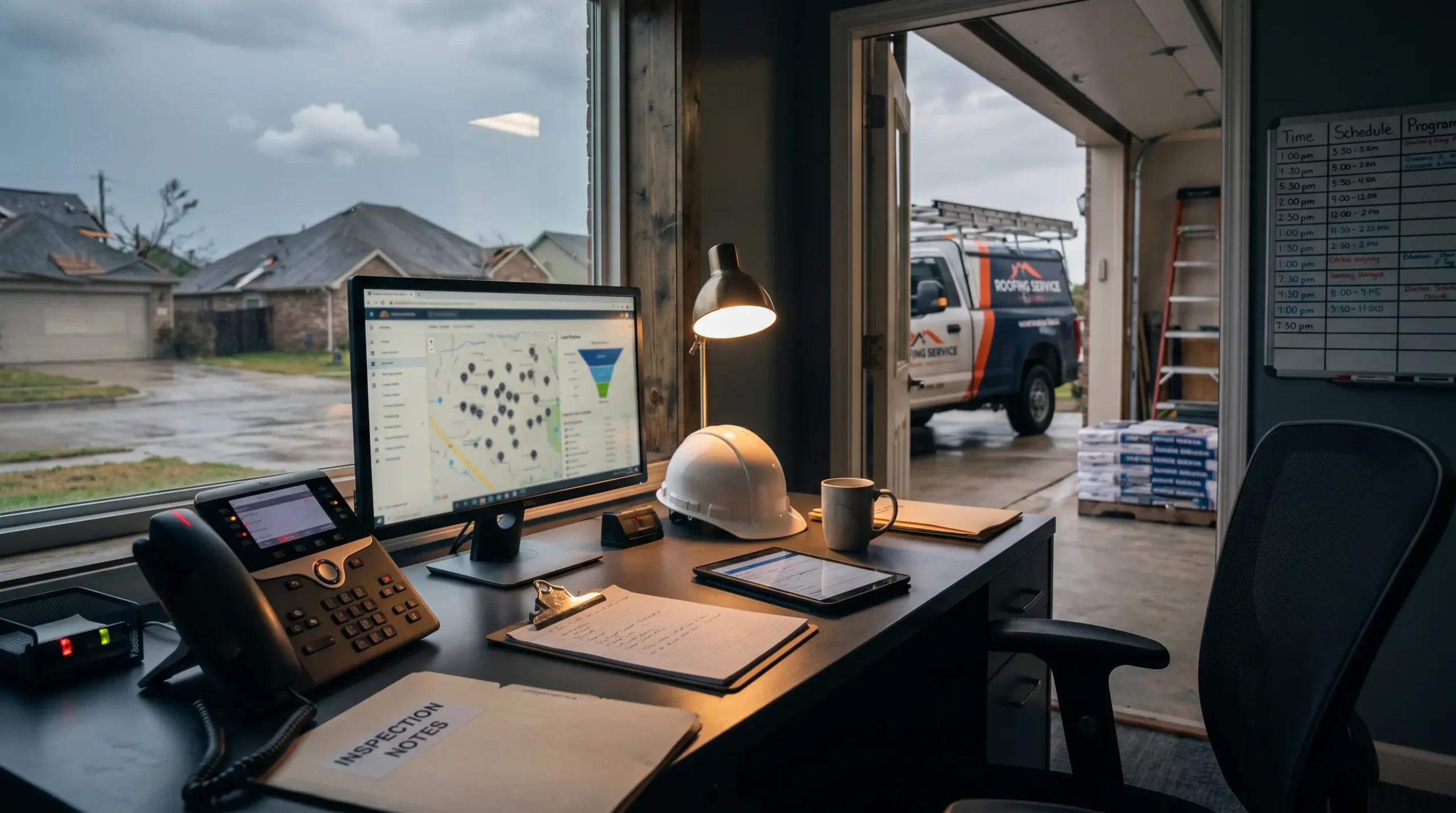
An AI agent for roofing contractors has quietly become the highest-leverage operational investment in modern home services — and most roofers still don’t realize the brutal math of the speed-to-lead game has now made AI deployment non-optional. Industry research from Invoca shows roofing contractors miss approximately 27% of inbound calls. According to Roofr’s 2026 industry data, over 40% of roofing leads go to the first contractor who responds, and leads contacted within 5 minutes are 9x more likely to convert than those contacted after 30 minutes.
Stack those numbers together with the size of roofing jobs — $5,000–$15,000+ for residential repairs and replacements, with storm damage averaging $8,000–$12,000 — and the math gets uncomfortable fast. A roofing company missing even 4 calls per day at typical close rates and average job values is leaking $45,000–$120,000+ in annual revenue. For storm-driven markets where seasonal lead volume can triple in 72 hours, the leak runs higher still.
The good news: an AI agent for roofing contractors now closes that gap. This article breaks down exactly how it works, what it costs, and why roofing has become one of the highest-ROI niches in the AI implementation market.
Why an AI Agent for Roofing Contractors Wins the Speed-to-Lead Game That Determines Who Books the Storm Damage Job
The roofing business sits at an unusual operational extreme.
1. Demand is intensely concentrated and unpredictable. A hail storm or major wind event can triple call volume in a single afternoon. There is no realistic way to staff for the spike. Roofers either answer 100% of inbound or watch their highest-value leads route to competitors with phones that get answered.
2. The first responder wins the job. Over 40% of roofing leads go to whoever responds first. Wait an hour, and your conversion rate craters. Wait a day — which is what the average roofing contractor does at 15–47 hours of response time — and the job is already signed elsewhere.
3. Lead costs are real. Roofing companies pay $150–$400 per qualified lead from shared lead services and Google LSAs. Every lead that doesn’t get a fast response wastes the marketing dollar that produced it.
4. Storm damage leads have a brutally short window. A homeowner with hail damage will pick a contractor within 48 hours. The roofer who shows up to inspect first usually books the entire job.
5. After-hours and weekend volume is essentially all lost. Storms hit on weekends. Trees fall at 8 PM. Without an AI agent for roofing contractors or 24/7 coverage, that volume routes to voicemail and the homeowner books someone else by morning.
The roofers winning in 2026 are not the ones with the biggest ad budgets. They’re the ones whose phones get answered in the first 30 seconds, 24/7, including the moments right after a storm hits.
What an AI Agent for Roofing Contractors Actually Does
A proper deployment of an AI agent for roofing contractors addresses five distinct workflows.
1. 24/7 AI Voice Reception With Storm-Aware Intake
The highest-leverage workflow. The AI answers every inbound call instantly, captures the property address, damage type (storm, leak, age-related), urgency level, and insurance involvement. Books inspections directly into the schedule. Escalates urgent water-intrusion situations to the on-call team.
2. Speed-to-Lead Web Response
When a homeowner submits a web form, fills out a Google LSA, or clicks a Meta ad, the AI responds within 30 seconds with a text that qualifies the lead, captures property details, and offers specific inspection times. Industry data shows this single workflow converts at 9x the rate of contractors who respond after 30 minutes.
3. Roofing CRM and FSM Integration
The AI talks to your CRM and field management software (JobNimbus, AccuLynx, ServiceTitan, Roofr) so inspections appear in the schedule automatically with full lead context.
4. Missed Call Text-Back
If a call slips through, an automated text fires within seconds: “Hi — this is [Roofing Company]. We just missed your call. Are you dealing with storm damage or a leak? I can text you available inspection times right now.” Industry data shows this recovers 20–40% of otherwise-lost leads.
5. Long-Tail Follow-Up Sequences
Most roofing prospects don’t commit on the first call. A proper system runs multi-touch follow-up over 7–14 days — texts, emails, occasional voice outreach — that surfaces buyers who weren’t ready in week one. Industry data shows 80% of sales require 5+ contacts.
Deployed correctly, the typical roofing contractor moves from 27% missed calls to under 5%, captures the post-storm lead spikes that previously overwhelmed the office, and lifts conversion by closing the response-time gap that determines who books the job.
What an AI Agent for Roofing Contractors Costs in 2026
Tool-only AI receptionist platforms: $199–$599/month. Real tools, but sold as software, not deployed solutions.
Managed AI agent for roofing contractors implementation: $1,500–$3,000/month per location plus a one-time setup fee. Covers voice reception, speed-to-lead automation, CRM integration, missed-call text-back, follow-up sequences, and ongoing monthly tuning.
Multi-location or franchise roofing groups: $3,000–$10,000/month.
Compare those numbers to:
- Hiring a dedicated lead-response specialist: $4,500–$7,000/month all-in
- Continuing to lose 40%+ of leads to whoever responds faster
- Continuing to leak $45K–$120K+ per year in lost revenue
- Continuing to pay $150–$400 per lead that never gets a 5-minute response
Why an AI Agent for Roofing Contractors Is One of the Highest-Margin Implementation Niches in 2026
For corporate professionals reading this and evaluating whether to build an AI implementation business serving roofing contractors — here’s the honest read.
Roofing is one of the strongest target niches available right now:
- The pain is universal and quantifiable. 27% miss rate, 9x conversion lift at 5 minutes, $45K–$120K annual leak — every contractor has this problem.
- Storm urgency drives extremely fast sales cycles. A roofer who lost storm leads last spring is signing before the next storm season.
- Job values support the math. $5,000–$15,000+ per job means even modest capture improvements deliver enormous ROI.
- The recurring revenue economics are strong. $1,500–$3,000/month per single-location client. 3–5 clients = a full-time corporate-equivalent income working a few hours a week.
I graduated from Vanderbilt. Almost went straight into investment banking. I spent years at Vanderbilt University reading reports about how AI was going to reshape the economy and decided early on that a salary has a ceiling, inflation doesn’t. I decided not to try and outrun inflation with a salary. I replaced my corporate salary by implementing pre-built AI tools we leverage — Intercom AI, Helios AI, and n8n — for local service businesses with exactly this operational gap.
According to McKinsey, 92% of companies have no clear AI strategy and only 3% offer AI implementation services. While 99% of people wait for the “right time,” smart operators are locking in roofing clients now.
What to Look for When Choosing an AI Agent for Roofing Contractors Partner
For roofing owners evaluating options:
- Roofing or home services specialization matters. A specialist understands storm damage workflows, insurance involvement, and inspection scheduling.
- CRM and FSM integration is non-negotiable. JobNimbus, AccuLynx, ServiceTitan, Roofr — your AI needs to talk to whatever you use.
- Ask about lead-to-inspection conversion outcomes. “We captured 47 leads and lifted lead-to-inspection conversion from 22% to 41%” is the right report.
- Avoid setup-only deployments. Recurring management is the entire reason your AI keeps converting.
The Bottom Line on AI Agent for Roofing Contractors
Roofers are not losing jobs because their workmanship is bad. They’re losing jobs because the phone rings during a storm and rolls to voicemail — and the homeowner books the contractor whose phone got answered.
An AI agent for roofing contractors closes that gap. At a cost that’s a fraction of what most companies already spend on the leads they can’t fully capture.
The phone is going to keep ringing — especially after the next storm. The only question is whether something answers.