
How to start an AI implementation business is the question quietly running through the heads of corporate professionals watching the last 18 months of AI development — and if you’ve been feeling the same low-grade dread most of them are feeling (that the salary career path you spent fifteen years building might not exist in its current form by 2030), you’re not paranoid. You’re paying attention.
In March 2026, Goldman Sachs surveyed 1,256 small business owners and found that 76% are already using AI in some capacity, but only 14% have embedded it into core operations. McKinsey reports that 92% of companies have no clear AI strategy, and only 3% currently offer AI implementation services. That gap — between the millions of businesses that need AI deployed properly and the tiny supply of people who can actually deploy it — is the opportunity.
You don’t bridge that gap by building AI from scratch. Not by raising venture capital. Not by going back to school for a master’s in machine learning. You bridge it by installing pre-built AI tools for local service businesses that desperately need them and don’t know how to install them themselves — and collecting a setup fee plus $1,500–$3,000 per month per client in recurring revenue.
This is the complete playbook on how to start an AI implementation business. The business model, the offer, the tools, the outreach, the pricing, the first client. If you’re going to actually start this business — not just bookmark this article and think about it for six months — read every section.
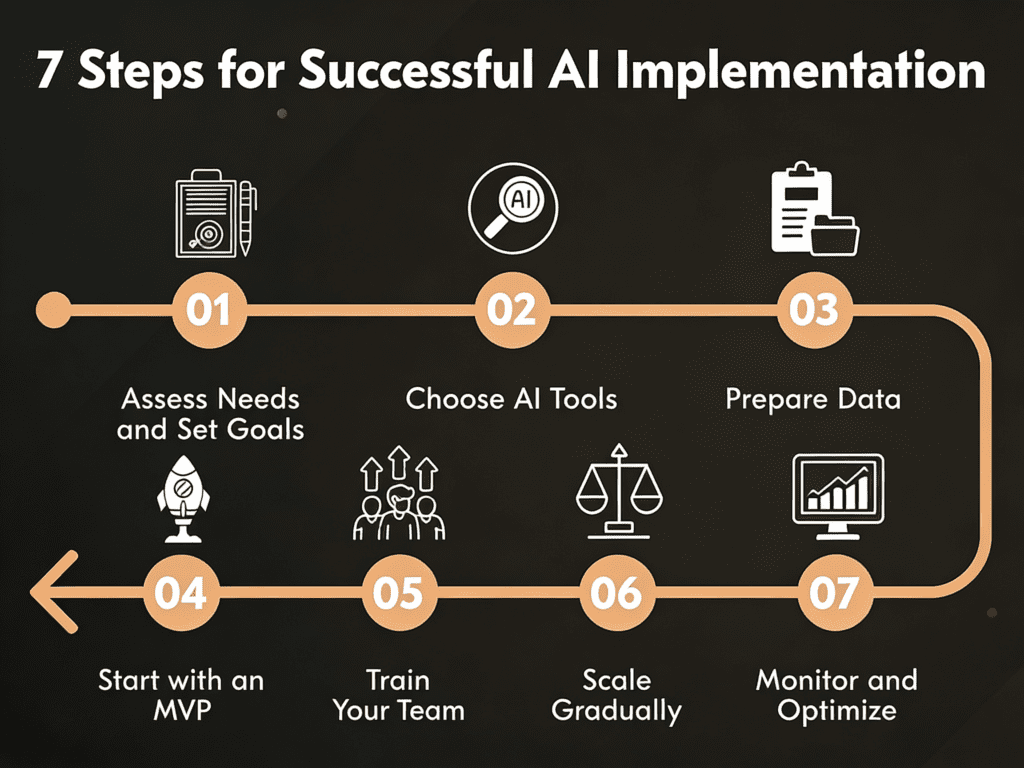
Why Now Is the Right Moment to Learn How to Start an AI Implementation Business
Before the playbook, the math. Because if you don’t believe the math, you won’t push through the resistance that hits in month two when nobody has signed yet.
There are roughly 36 million small businesses in the United States. The vast majority of them share the same operational problem: a front desk that misses 20–40% of inbound calls, after-hours coverage that’s essentially zero, a labor market with nobody left to hire as a receptionist, and marketing dollars getting lit on fire because leads can’t reach a human.
Industry data across dental, HVAC, auto repair, med spas, veterinary, chiropractic, plastic surgery, and fertility consistently shows that local service businesses are leaking $50,000 to $500,000+ per year in lost revenue from unanswered phones and slow follow-up. They feel the leak. They just don’t have a number on it, and they don’t know how to fix it without hiring more people they can’t hire.
That’s the entire opening for your business.
The pattern playing out right now is identical to what happened with Facebook ad agencies between 2011 and 2015, SEO agencies between 2008 and 2012, and e-commerce agencies between 2015 and 2020. A new technology arrives. For a brief moment, the supply of competent operators is dramatically smaller than the demand from businesses that need it. Early operators sign clients at prices late operators can only dream of. Then the wave hits, the market floods, prices compress, and the operators who got in early have a 5-year head start nobody catches.
We’re somewhere around the 2011 moment for AI implementation. The first wave is in the water. The mass wave hasn’t hit yet.
I graduated from Vanderbilt. Almost went straight into investment banking. I spent years at Vanderbilt University reading the same labor reports and McKinsey decks that economists, finance professionals, and consulting firms have been reading — and I came away with one inescapable conclusion: a salary has a ceiling. Inflation doesn’t.
I decided not to try and outrun inflation with a salary. I replaced my corporate salary by doing exactly what this playbook describes.
While 99% of people wait for the “right time,” smart operators are locking in clients now.
Step 1 — Pick One Industry to Serve
The single most common mistake first-time operators make when learning how to start an AI implementation business is trying to be a “general AI automation agency for any business.” That’s a death sentence. Generalists lose to specialists in service businesses every time.
You need to pick one industry and become the obvious choice in it. Six industries are working extremely well for first-time operators in 2026:
- Med spas — high transaction values ($400–$800), intense lead competition, owners who already buy expensive software
- Dental and orthodontic practices — front desk overload is universal, owners are time-poor, $4,500–$7,000/month role replacement is standard
- HVAC and home services contractors — seasonal demand spikes that AI handles better than humans, owners often technically curious
- Auto repair shops — high call volume, simple booking workflow, friendly to AI deployment
- Veterinary clinics — 40% of calls come after hours (highest of any healthcare type), emotional buyer, intense pain
- Chiropractic and physical therapy — recurring care plans, retention problems, easy ROI math
How to choose: pick the one where you have some personal connection or natural credibility. If your spouse is a dentist, pick dental. If you grew up around HVAC, pick HVAC. If you’ve spent the last five years as a med spa client, pick med spas. The “warm” industry knowledge from your own life accelerates your first six months dramatically.
Your messaging, your case studies, your outreach scripts, and your delivery system all sharpen when you stop trying to serve everyone.
Step 2 — Understand What You’re Actually Selling
Most first-time operators try to sell “AI.” That’s the wrong product.
You are not selling AI. You are selling replacing a $6,000+/month employee role with a system that works 24/7, never calls in sick, and captures calls the front desk currently misses.
The framing matters because the buyer is not a technical person. They don’t care about LLMs, voice synthesis, or workflow automation. They care about:
- Why their phone keeps ringing without anyone answering
- Why they’re paying their receptionist $4,500/month and still losing leads
- Why they spend $10,000/month on Google Ads that generate calls they can’t capture
- Why their competitor across town just expanded to a second location while they’re stuck at one
Your offer in plain language: “I install and manage a system that answers every inbound call instantly, books appointments directly into your scheduling software, follows up on missed calls, and runs 24/7. It replaces the work of an additional front-desk employee at a fraction of the cost, and it pays for itself in the first 30–45 days from captured calls alone.”
That’s the entire pitch. Memorize it. Internalize it. Technical details come later, only if the buyer asks.
Step 3 — The Three Core Tools You Need to Start an AI Implementation Business
You don’t need to learn every AI tool on the market. You need to learn three tools well enough to deploy a working system in 2–3 hours and explain it to a 55-year-old business owner in language she actually understands.
The pre-built AI tools we leverage:
- Intercom AI — chat and inbound conversation layer
- Helios AI — voice and phone-based AI agents
- n8n — workflow automation glue that connects everything to the business’s existing software
If you’re already comfortable with software, this is a 30–60 day learning sprint. If you’re starting from a non-technical background, plan for 60–90 days of focused work alongside your day job.
The depth you need: enough to install the system confidently, integrate it with the scheduling software your target industry uses (Boulevard, ServiceTitan, Dentrix, Mitchell 1, Cloud 9, etc.), and tune it monthly. You’re not training models. You’re not writing production code. You’re configuring tools that already exist.
If you can run a Shopify store without knowing how to build Shopify, you can run this business without knowing how to build the underlying AI.
Step 4 — Set Your Pricing
Here’s the actual pricing structure that works in 2026:
- Setup fee: $3,500–$7,500 one-time. Lower for simple deployments, higher for complex ones (multi-location, EMR integration, custom workflows).
- Monthly management fee: $1,500–$3,000/month per location. Higher for high-case-value industries (plastic surgery, fertility, orthodontics at $2,500–$4,500), lower for high-volume low-ticket industries.
- Multi-location operators: $3,000–$10,000/month with custom pricing based on locations, call volume, and reporting requirements.
Tooling cost per client typically runs $200–$600/month depending on call volume and integrations. At a $2,000/month retainer, your margins are 70–90%.
The math compounds fast:
- 3 clients × $2,000/month = $6,000/month recurring
- 5 clients × $2,000/month = $10,000/month recurring
- 10 clients × $2,000/month = $20,000/month recurring
3–5 clients = a full-time corporate-equivalent income working a few hours a week. 10 clients = a six-figure income from work that fits inside a normal week. The model compounds because every client you sign generates monthly income that stacks on top of the last one — rather than resetting to zero every January like a corporate bonus.
Step 5 — Get Your First Client Through Direct Outreach
This is where most first-time operators get stuck. They build the perfect website. They set up a sales funnel. They write a Notion doc explaining their offer. Then they post about it on LinkedIn and wait for inbound to materialize.
That’s not how the first 3–5 clients come in. The first 3–5 clients come from direct outreach. Specifically targeted, specifically written, sent to specifically chosen business owners in your one industry.
The math:
- List 100 local businesses in your target industry
- Send a short, specific message to each owner
- Expect a 5–10% response rate
- Expect 2–4 of those responses to turn into discovery calls
- Expect 1–2 of those calls to convert to clients
The outreach message that works:
“Hi [Name] — I noticed [specific thing about their business that signals you actually looked at it]. I set up AI phone systems for [specific industry] that capture the calls your front desk is missing — typically 20–30% of inbound. Would you be open to a 15-minute call where I show you how many calls you’re missing this month and what it’s worth? No pitch, just data.”
Short. Specific. No fluff about “leveraging cutting-edge AI.” No mention of features. Just the problem and an offer to quantify it.
Where to find the 100 owners:
- Google Maps (search “[industry] near [city]” and pull the top 100)
- Industry-specific directories and associations
- LinkedIn filtered by industry + owner/founder role
- Local Chamber of Commerce member lists
100 prospects in one industry in one geographic area will outconvert 1,000 prospects scattered across 10 industries every time.
Step 6 — Run the Discovery Call
Once an owner responds, here’s the structure that closes:
Minute 1–3: Set the frame. Understand their setup, team size, and rough call volume. You need this for the live audit.
Minute 4–10: Run the audit live. This is what separates you from every other AI vendor. Calculate their specific revenue leak in real time.
“Okay, so you’re getting roughly 50 calls per day. Industry data for [their industry] shows the average practice misses 22–30%. Even if you’re at the better end — let’s say 20% — that’s 10 missed calls per day, 220 per month. At your average case value of $X, even if just 10% would have booked, that’s [calculate]. So conservatively, you’re losing $Y per month right now.”
The math is the entire pitch. You don’t have to convince them. You just have to compute it. Most owners are visibly surprised. Many ask you to recalculate. The number is almost always bigger than they expected.
Minute 10–15: Explain the solution in plain language. No deck, no slides, no 47-feature comparison chart. Setup fee, monthly fee, what they get, when it goes live, when they see results.
Minute 15–20: Close or schedule the next step. If they’re ready, sign on the call. If they need to think, schedule a specific follow-up time. If they say no, ask what specifically the concern is.
Step 7 — Deliver the First Client With Obsessive Care
Your first client is the asset that funds everything that comes after. Over-deliver. Document everything. Take screenshots of the before-and-after metrics:
- Missed calls before vs. after
- Leads captured before vs. after
- Response time before vs. after
- Booked appointments captured by the AI
That documentation becomes your case study. The case study turns clients 2 through 5 into closes that take half the time of client one.
Build the system in roughly a week:
- Week 1: Discovery and audit — pull 30 days of their call data, identify the leak in their own dollars, get the contract signed.
- Week 2: System build — configure Helios AI for their voice agent, Intercom AI for chat, n8n for the workflow automation connecting it all to their existing scheduling and CRM. The actual hands-on configuration takes 2–3 hours once you’ve done it a few times.
- Week 3: Soft launch — AI handles overflow calls and after-hours initially while you and the client review every interaction for quality.
- Week 4: Full deployment — AI becomes the primary handler for inbound calls during peak hours, after hours, and lunch. The client’s team shifts toward higher-value work.
Ongoing: Monthly optimization. This is where your recurring revenue actually comes from. AI systems drift. New use cases emerge. Seasonal patterns change. The clients who keep paying $2,000+/month for years are the ones where you’re actively monitoring calls, tuning the system prompt, updating the knowledge base, and reporting outcomes monthly.
Step 8 — Scale From 1 to 3, Then 3 to 10
The hard math: client one to client three is the steepest part of the climb. Client three to client ten is dramatically easier.
The reasons:
- You now have a real case study with real numbers
- Your delivery is productized — the same playbooks, the same prompts, the same workflows
- Referrals start happening organically because your first three clients tell other owners in their industry
- Your outreach response rates increase because you can reference specific results
Most first-time operators reach 3–5 clients within 6–12 months of focused work. At that point you face a choice:
- Stay at this size and treat the income as your real freedom number (3–5 clients × $2,000/month = $72,000–$120,000/year working a few hours a week)
- Hire a delivery person or a sales person and scale to 10–25 clients ($240,000–$750,000/year)
- Productize a specific workflow and sell it to a niche at higher volume
There’s no wrong answer. The point is you have the choice — which is something a corporate salary has never given you and never will.
How to Start an AI Implementation Business vs. Staying in Corporate
For a corporate professional reading this and trying to decide whether to do this — here’s the honest comparison.
Corporate path:
- $100K–$300K annual salary
- Single point of failure (one bad quarter, one new CFO, one restructuring)
- Income ceiling defined by your title
- 40–60 hours per week
- No equity, no asset you own
- Layoff risk that materially increases every year as AI eats more white-collar work
AI implementation business:
- $0 in month one, possibly $5K–$15K in month three after first client
- 3–5 clients = full-time income within 6–12 months of focused work
- Income scales with client count, not title
- 10–20 hours per week at steady state
- You own the business as an asset
- Diversified across multiple clients, no single point of failure
Neither path is obviously better in every dimension. The corporate path offers stability if you stay employed. The agency path offers ownership if you do the work.
What’s no longer true is that the corporate path is automatically the safer one. The math on white-collar layoffs has changed permanently. A diversified small business with recurring revenue from five local service clients is now, in many cases, more stable than a single corporate role at a name-brand employer.
How to Start an AI Implementation Business This Week — The First Actual Step
If you’ve read this far and you’re going to do this — not just bookmark the article — here’s what tomorrow looks like:
- Pick the one industry. Spend 48 hours deciding. Don’t over-research.
- Spend the next 30–60 days learning Intercom AI, Helios AI, and n8n. Free documentation, free trials, free training.
- Build a one-page service description with your industry, your offer, and your pricing visible.
- Send 25 direct outreach messages to local business owners in your target industry. Not 1,000. Twenty-five, well-written, specific. To scale you can use AI tools like Victoria AI.
- Run the discovery calls that come back. Sign the first client. Over-deliver. Document everything.
That sequence — picked one industry, learned three tools, sent 25 messages, signed first client, over-delivered — is how almost every working AI implementation business in 2026 actually started.
The professionals who win in this space are not the ones with the most impressive backgrounds. They’re the ones who decided to learn a skill instead of buying into a business model — the salary model — that just stopped working.
The clients are out there right now. The phone is ringing at every local business in your zip code. The only thing missing is the operator who shows up.
That can be you. The math works. The model works. The timing works.
Pick the industry. Take the first step.
Watch the full playbook >> here.