
How to Build a Recurring Revenue Business Selling AI Receptionists to Local Businesses in 2026
Selling AI receptionists to local businesses is the highest-ROI agency model available right now — and if you’ve spent any time looking at the AI implementation business, the question that probably stalled you wasn’t whether the business works. It was how do you actually sell this thing?
Most articles about AI receptionists are written for the buyers — the dental practices, the HVAC contractors, the med spa owners. This article is written for the operators. The people thinking about being the ones who walk in, set up the AI, and collect $1,500–$3,000 per month per client in recurring revenue.
This is the actual playbook. The pitch. The build process. The pricing math. The objection handling. The path from zero clients to a portfolio that replaces a corporate salary working a few hours a week.
Let’s go.
Why Selling AI Receptionists to Local Businesses Is the Single Best Implementation Opportunity of 2026
Before the playbook, the math. Because if you don’t believe the math, you won’t sell with conviction — and local business owners can smell that across a Zoom call.
There are roughly 36 million small businesses in the United States. The vast majority of them share the same operational problem: a front desk that misses 20–40% of inbound calls, after-hours coverage that’s essentially zero, and a labor market where there’s nobody left to hire as a receptionist. Industry data across dental, HVAC, auto repair, med spas, veterinary, and chiropractic consistently shows missed call rates of 22–38% during business hours and near-100% after hours.
The math on what that costs the business is brutal. Most local service businesses are leaking $50,000–$500,000 per year in lost revenue from unanswered phones — depending on case values and call volume. A med spa loses $130,000+ per year from three missed calls a day. A dental practice loses $10,000–$50,000 per month. A plastic surgery practice can lose $1M+ annually.
The business owner already knows the leak is happening. They feel it. They just don’t have a number on it, and they don’t know how to fix it without hiring more people.
That’s the entire opening for your business.
According to McKinsey, 92% of companies have no clear AI strategy and only 3% currently offer AI implementation services. The supply of competent AI implementers is dramatically smaller than the demand from small businesses that need an AI receptionist. That ratio is the entire opportunity, and it’s the same pattern that played out with Facebook ad agencies between 2011 and 2015, with SEO agencies between 2008 and 2012, and with e-commerce agencies between 2015 and 2020. The early operators built businesses the late entrants never caught.
While 99% of people wait for the “right time,” smart operators are locking in clients now.
What You’re Actually Selling (Get This Right Before You Pitch)
Most first-time operators try to sell AI. That’s the wrong product.
You are not selling AI. You are selling replacing a $6,000+/month employee role with a system that works 24/7, never calls in sick, and captures calls the front desk currently misses.
The framing matters because the buyer is not a technical person. They don’t care about LLMs, voice synthesis, or workflow automation. They care about:
- Why their phone keeps ringing without anyone answering
- Why they’re paying their receptionist $4,500/month and still losing leads
- Why they spend $10,000/month on Google Ads that generate calls they can’t capture
- Why their competitor across town just expanded to a second location while they’re stuck at one
Your offer in plain language: “I install and manage a system that answers every inbound call instantly, books appointments directly into your scheduling software, follows up on missed calls, and runs 24/7. It replaces the work of an additional front-desk employee at a fraction of the cost, and it pays for itself in the first 30–45 days from captured calls alone.”
That’s the entire pitch. Memorize it. Internalize it. The technical details come later, only if the buyer asks.
The Actual Build Process for Selling AI Receptionists to Local Businesses
Here’s the part most articles skip. If you’re going to sell this confidently, you have to know how the build actually works — because owners will ask, and “I have a team that handles that” doesn’t close deals at this stage.
The pre-built AI tools we leverage are Intercom AI, Helios AI, and n8n. Each plays a specific role:
- Helios AI handles the voice agent itself — the actual phone conversation
- Intercom AI handles chat and inbound web interactions
- n8n handles the workflow automation that connects everything to the business’s existing software (scheduling, CRM, dispatching, EMR, etc.)
For a typical local business — let’s use a gym or fitness studio as an example, since the build is identical for any service business with a front desk — the deployment takes roughly 2–3 hours of actual hands-on time once you’ve done it a few times.
Step 1: Build the Knowledge Base
The AI needs to know everything about the business. Hours, services, pricing, location, frequently asked questions, what to say in specific scenarios, how to handle objections, when to escalate to a human.
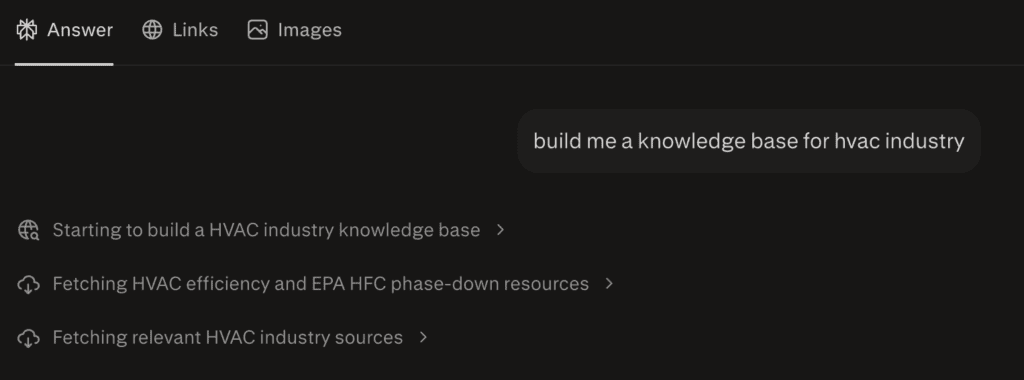
You can build this from scratch, but it’s faster to start with a template knowledge base from a similar client and customize it. Tools like Perplexity will pull a website and generate a structured knowledge base in a few minutes — you give it the URL and the format you want, and it does the research.
For example: “Build me a knowledge base for [client website] using this template structure.” Perplexity pulls the site, identifies the services, hours, location, FAQs, and outputs a clean structured document. You then download it as a PDF and you’re ready to upload.
Step 2: Upload the Knowledge Base Into Helios AI
Inside Helios AI, navigate to the AI assistant module and create a new knowledge base. Upload the PDF you just built. Helios processes it — typically takes under a minute.
This is the knowledge layer your voice agent will draw from. Anything the AI needs to know about the business has to be in this document.
Step 3: Build the System Prompt
The system prompt is the instruction set that tells the AI how to behave. Tone, persona, escalation rules, what NOT to do, how to handle specific scenarios.
For a fitness studio: warm but professional, offers to book gym tours, captures contact info, escalates to a human for membership pricing discussions, never quotes specific medical advice, etc.
The system prompt is the most important piece of the deployment. A great knowledge base with a weak system prompt produces a generic AI. A great system prompt with a basic knowledge base produces an AI that sounds like it actually works at the business.
You’ll iterate on the system prompt for the first 2–3 weeks of every deployment. That’s normal.
Step 4: Configure the AI Assistant
Inside Helios AI, create a new AI assistant, name it (e.g., “Gym Assistant”), paste in the system prompt, and configure the first message — the opening line callers hear. For example: “Thanks for calling Midtown Athletic Club. This is Maya. How can I help you today?”
Voice selection matters more than people realize. Helios offers multiple voices — Aria, Emily, and others — and the right voice for a fitness studio is different from the right voice for a dental practice or a plastic surgery clinic. Choose one that matches the brand.
Step 5: Test the Agent Before Going Live
Before you hand the system to the client, you test it. Make actual calls. Pretend to be a customer trying to book a gym tour. Pretend to be a confused caller asking about pricing. Pretend to be someone trying to cancel.
A test call for the gym example might go like this:
Maya: “Thanks for calling Midtown Athletic Club Bannockburn. This is Maya. How can I help you today?”
Caller: “Hey Maya, I’m looking to come in and view the gym. Looking to test it out or maybe see if it’s a good fit.”
Maya: “Absolutely. Coming in for a visit is a great way to get a feel for the club. Do you have a day that works well for you to come by?”
Caller: “Potentially this week. Maybe Tuesday, May 5th.”
Maya: “Got it. Tuesday, May 5th. What time works best for you that day?”
Caller: “12:30 Eastern.”
Maya: “Just to confirm, that would be 11:30 AM our time here in Bannockburn. Does that work for you?”
That’s a real captured tour. The AI handled timezone conversion, gathered the name and callback number, confirmed the details back, and booked the visit — all without a human touching the phone. That call would have gone to voicemail at most fitness studios.
Step 6: Attach a Phone Number and Go Live
Once the AI passes your testing, attach it to the client’s phone number. You can either port their existing number to Helios or set up call forwarding from their current carrier. Go-live typically happens within 1–3 days of finishing the build.
Step 7: Set Up Workflow Automation in n8n
This is where the real value layer sits. n8n connects the AI to:
- The client’s scheduling software (so appointments book directly)
- The client’s CRM (so contact info flows in automatically)
- The client’s SMS provider (so missed-call text-backs fire)
- The client’s email system (so confirmations send)
- The client’s reporting layer (so the owner can see captured calls every morning)
Without n8n, the AI is just an answering service. With n8n, it’s an actual operational system that integrates with the business’s existing tools.
Step 8: Monthly Optimization
This is where the recurring revenue comes from. AI systems drift. New use cases emerge. Seasonal patterns change. The clients who keep paying you $2,000+ per month indefinitely are the ones where you’re actively monitoring calls, tuning the system prompt, updating the knowledge base, and reporting outcomes monthly.
That’s the entire build. From signed contract to live AI in roughly a week, with ongoing management thereafter.
How to Find Your First Client (The Outreach Playbook)
Most first-time operators get stuck here. They build the perfect website. They set up a sales funnel. They write a Notion doc explaining their offer. Then they post about it on LinkedIn and wait for inbound.
That’s not how the first 3–5 clients come in. The first 3–5 clients come from direct outreach. Specifically targeted, specifically written, sent to specifically chosen business owners in a specific industry.
Here’s the math:
- List 100 local businesses in one target industry (med spas, dental, HVAC, vet, chiropractic, etc.)
- Send a short, specific message to each owner
- Expect a 5–10% response rate
- Expect 2–4 of those responses to turn into discovery calls
- Expect 1–2 of those calls to convert to clients
This is not magic. It’s not a viral content strategy. It’s not a thousand cold emails sprayed at a list. It’s 100 specific messages to 100 specific business owners who already have the problem you solve.
The Outreach Message Template
Here’s the actual structure that works:
“Hi [Name] — I noticed [specific thing about their business that signals you actually looked at it]. I set up AI phone systems for [specific industry] that capture the calls your front desk is missing — typically 20–30% of inbound. Would you be open to a 15-minute call where I show you how many calls you’re missing this month and what it’s worth? No pitch, just data.”
That’s it. Specific. Short. No fluff about “leveraging cutting-edge AI.” No mention of features. Just the problem and an offer to quantify it.
The response rate on this kind of message is dramatically higher than generic “would you like to learn about AI?” cold emails because it presupposes the problem and offers value (the audit) before asking for anything.
Where to Find the 100 Owners
For each target industry, you can pull lists from:
- Google Maps (most reliable — search “med spa near [city]” and pull the top 100)
- Yelp business directories
- Industry-specific associations (state dental associations, ACA chiropractic directory, etc.)
- LinkedIn (filter by industry + owner/founder role)
The trick is not breadth, it’s depth. 100 prospects in one industry in one geographic area will outconvert 1,000 prospects scattered across 10 industries every time.
The Discovery Call (How to Run the Conversation)
Once an owner responds and books the call, here’s the actual structure:
Minute 1–3: Set the frame “Thanks for taking the time. Before I show you anything, I just want to understand your situation — how big is your team, what does your current phone setup look like, and what’s the rough call volume?”
This isn’t small talk. You need this information to do the math live in the next step.
Minute 4–10: Run the audit live This is where you do something almost no AI vendor does: you calculate their specific revenue leak in real time.
“Okay, so you’re getting roughly 50 calls per day. Industry data for [their industry] shows the average practice misses 22–30% of those. Even if you’re at the better end of that — let’s say 20% — that’s 10 missed calls per day, or roughly 220 per month. At your average case value of $X, even if just 10% of those would have booked, that’s [calculate the number]. So conservatively, you’re losing $Y per month right now to calls that don’t get answered.”
The math is the entire pitch. You don’t have to convince them — you just have to compute it. Most owners are visibly surprised. Many ask you to recalculate. The number is almost always bigger than they expected.
Minute 10–15: Explain the solution in plain language “Here’s what I’d do for you. I set up an AI voice agent that answers every inbound call instantly — no rings to voicemail, no hold time. It books appointments directly into [their software], handles after-hours coverage, and sends a follow-up text on any missed call. Setup takes about a week. Setup fee is $X. Monthly management is $Y. The system pays for itself in the first 30–45 days from captured calls alone.”
That’s it. No deck. No slides. No 47-feature comparison chart. The owner already wants to fix the leak — your job is to be the obvious person who can fix it.
Minute 15–20: Close or schedule next step If they’re ready to go, sign the contract on the call. If they need to think about it, schedule a specific follow-up call (not “I’ll send you info” — an actual scheduled time). If they say no, ask what specifically the concern is.
Pricing the Offer When Selling AI Receptionists to Local Businesses
Here’s the actual pricing structure most operators use successfully in 2026:
- Setup fee: $3,500–$7,500 one-time. Lower for simple deployments (single location, basic scheduling), higher for complex ones (multi-location, EMR integration, custom workflows).
- Monthly management: $1,500–$3,000/month per location. Higher for high-case-value industries (plastic surgery, fertility, orthodontics — $2,500–$4,500), lower for high-volume low-ticket industries.
- Multi-location operators: $3,000–$10,000/month with custom pricing based on locations, call volume, and reporting requirements.
Cost of the underlying tooling per client typically runs $200–$600/month depending on call volume and integrations. At a $2,000/month retainer, your margins are 70–90%.
3–5 clients at $2,000/month each generates $6,000–$10,000/month in recurring revenue. 10 clients generates $20,000/month. 20 clients generates $40,000+/month. The work scales sublinearly because every new client uses the same underlying tools, the same playbooks, and increasingly the same templates.
That’s why the model works. The recurring revenue compounds while the marginal time required per client shrinks.
Handling the Three Most Common Objections When Selling AI Receptionists to Local Businesses
Objection 1: “Will my customers know it’s AI?”
The honest answer: with modern voice technology (Helios AI in particular), most callers don’t realize it’s an AI unless they specifically ask. The voices are natural, the response timing is human, and the conversation flows like a regular call. For the small percentage of callers who do ask, your system prompt can be configured to acknowledge it transparently — but most callers don’t ask.
The bigger point: your customers care that someone answered the phone, not whether that someone was a human. The current alternative isn’t a human — it’s voicemail.
Objection 2: “We already have a receptionist.”
Great. Your AI doesn’t replace your receptionist. It backs them up during lunch, peak hours, and after they go home for the day. It handles the calls they physically can’t answer. It’s a supplement, not a substitute — unless the owner specifically wants it as a substitute, which sometimes they do.
Objection 3: “What if it makes a mistake on a call?”
Every system makes mistakes. Human receptionists make mistakes. The difference is the AI learns systematically — every flagged interaction becomes a tuning opportunity. Your monthly management process specifically catches and corrects errors. By month three, your AI typically outperforms the existing front desk on accuracy, consistency, and tone — because the AI doesn’t have a bad day.
Why Selling AI Receptionists to Local Businesses Beats Going Back to Corporate
For corporate professionals reading this — currently earning $100K+ in a role you’re not sure will exist in three years — here’s the honest comparison.
A salary has a ceiling. Inflation doesn’t.
I graduated from Vanderbilt. Almost went straight into investment banking. I spent years at Vanderbilt University reading reports about how AI was going to reshape the economy and decided early on that the corporate path was a structurally weaker bet than building something I owned. I decided not to try and outrun inflation with a salary. I replaced my corporate salary doing exactly what this article describes — implementing pre-built AI tools we leverage for local service businesses that need them and don’t know how to install them themselves.
The reason this works for non-technical professionals is that the modern AI stack is built for non-technical operators. You’re not building Anthropic. You’re not training models. You’re not writing production code. You’re installing tools that other people already built — the same way someone runs a Shopify store without knowing how to build Shopify.
3–5 clients = a full-time corporate-equivalent income working a few hours a week. The income compounds rather than capping out. No single client can fire you in a way that wipes out your income. You own the business as an asset.
The window is open right now. The supply of competent AI implementation operators is dramatically smaller than the demand from small businesses that need an AI receptionist. That gap is going to close. It always does. The operators who get in early at the implementation layer build businesses the late entrants never catch.
The Actual First Step to Start Selling AI Receptionists to Local Businesses
If you’ve read this far and you’re actually going to do this — not just bookmark the article — here’s the practical sequence:
- Pick one industry to specialize in. Med spas, dental, HVAC, vet, chiropractic, orthodontics, plastic surgery, fertility, IV/wellness. Pick one. Don’t be a generalist.
- Spend 30 days learning Helios AI, n8n, and one workflow tool deeply. Not surface-level. Deep enough to deploy a working system in 2–3 hours.
- Build one demo deployment for a fake client in your target industry. Record the test calls. This becomes your proof.
- Send 25 specific outreach messages to local business owners in your target industry. Not 1,000. Twenty-five, well-written, specific.
- Run the discovery calls. Sign the first client. Over-deliver. Document everything.
That sequence — picked one industry, learned the tools, sent 25 messages, signed first client, over-delivered — is how almost every working AI implementation agency in 2026 actually started.
The professionals who win in this space are not the ones with the most impressive backgrounds. They’re the ones who decided to learn a skill instead of buying into a business model — the salary model — that just stopped working.
The clients are out there right now. The phone is ringing at every local business in your zip code. The only thing missing is the operator who shows up.
That can be you. The math works. The model works. The timing works.
Pick the industry. Take the first step.
If you’re ready to take the leap and learn from team that’s already helping hundreds of corporate professionals launch and scale AI Implementation businesses, watch the training here and join us on the inside.