Three years ago, “AI automation agency” wasn’t a real category. The handful of people doing it called themselves consultants, freelancers, or implementation specialists, and most small business owners had no idea what they actually did.
That’s no longer the case.
In 2026, “AI automation agency” is one of the fastest-growing search terms in the small business space. Industry data now puts standard project fees between $5,000 and $15,000 for pilot work, with monthly retainers ranging from $2,500 to $15,000 for ongoing management. LinkedIn ranks AI engineer as the #1 fastest-growing job title in the US. McKinsey reports that 92% of companies have no clear AI strategy and only 3% currently offer AI implementation services. The gap between businesses that need AI and people who can install it for them is the largest single market opportunity of this decade.
This guide breaks down exactly what an AI automation agency is, what it costs to start one, what clients are actually paying in 2026, and how non-technical professionals are building these businesses to full-time income within 6–12 months — often while still in their corporate roles.
Let’s get into it.
What an AI Automation Agency Actually Is
An AI automation agency is a small service business that installs and manages pre-built AI tools for other businesses — usually small to mid-sized companies that need AI but don’t have the technical staff to deploy it themselves.
In plain language: a med spa owner knows their front desk is drowning. Calls go unanswered, leads stop responding, and they’re paying a receptionist $4,500 a month plus benefits to manage a system that breaks every weekend. They’ve read about AI. They don’t know where to start. They google around, find platforms with confusing pricing and 47 features they don’t understand, give up, and go back to running their business.
An AI automation agency walks in, identifies which expensive repetitive role is costing them the most money, sets up the right pre-built AI tools to handle that role (typically Intercom AI, Helios AI, and n8n stitched together), trains the staff, and stays on retainer to manage the system.
That’s the entire business. There’s no product to build. No code to write from scratch. No engineering team. You’re an implementer, not an inventor.
The Three Things You’re Actually Selling
Buyers researching AI automation agencies in 2026 are paying for three things, in this order:
- The diagnosis. Most owners don’t know which workflow to automate first. The right answer is usually whichever role is costing them the most money and producing the most repetitive output. Lead intake, appointment booking, and customer follow-up are the top three across almost every industry.
- The implementation. Picking the right tools, configuring them for the specific business, integrating with their existing CRM or scheduling system, and getting it live in a few days.
- The ongoing management. AI systems drift. Prompts need tuning. New use cases come up. This is where the recurring revenue comes from — and it’s the part most clients value most once they realize their AI receptionist sometimes hallucinates and needs a human checking the work.
If you understand those three pieces, you understand the entire business.
The AI Automation Agency Business Model (in Plain Numbers)
This is the part most articles dance around. Let’s just lay it out.
Setup Fee
Charged once, when you onboard a new client. Industry data shows the market range is $5,000–$15,000 for small to mid-sized business pilots, with enterprise builds running far higher.
For the kind of work that targets local service businesses (med spas, dental offices, HVAC, auto repair, dealerships, law firms, real estate brokerages), the realistic sweet spot is a setup fee that covers your time, signals that you’re a serious operator, and is small enough to clear an owner’s signing authority without needing board approval.
The model I run uses a setup fee at signing plus a recurring monthly fee starting the same month. Owners pay it because the AI replaces a role costing them $6,000+ per month. The math is obvious on the first conversation.
Monthly Recurring Revenue Per Client
This is the engine. Industry retainers in 2026 typically run $2,500–$15,000 per month for full system management, with simpler engagements at $500–$2,000.
The number I see working consistently for SMB-focused agencies is $1,500–$3,000 per month per client. Below that, you’re undercharging and you’ll struggle to deliver real management. Above that, you’re outside the comfort zone of most small business owners — and there are dramatically more small business owners than enterprise buyers in this country.
Why this range works:
- It’s below the cost of the employee you’re replacing ($6,000+/month for a single front-desk role with benefits)
- It clears the owner’s “no-brainer” threshold instantly
- It compounds fast: 3 clients = $4,500–$9,000/month, 5 clients = $7,500–$15,000/month, 10 clients = $15,000–$30,000/month
Client Threshold for Full-Time Income
The math: 3–5 clients = a full-time corporate-equivalent income working a few hours a week.
That sentence sounds like hype, so let’s pressure-test it.
- 4 clients × $2,000/month = $8,000/month recurring = $96,000/year
- Plus 4 setup fees = additional one-time revenue
- Plus the next year’s clients stacking on top of these
A $100K+ corporate salary requires 40–60 hours of your week. Four AI implementation clients require ~5–10 hours per week once the systems are running, because the work is mostly monitoring, occasional prompt tuning, and a monthly check-in call.
This is not a get-rich-overnight pitch. The first client takes work. The second is easier. By client five, you’ve productized your delivery and the work shrinks dramatically. That’s the entire point of recurring revenue compared to a salary — every client you sign generates monthly income that stacks on top of the last one, rather than resetting to zero every January.
Margins
Tooling costs (Intercom AI, Helios AI, n8n, plus any CRM or scheduling integrations) typically run $200–$600 per client per month, depending on volume. At a $2,000 monthly retainer, your margins are 70–90%. There’s almost no other business model with margins this clean at this revenue level.
How Much Does AI Automation Cost? (For the Client)
This is what your prospects are searching for. They want a number before they call. Here’s how to think about it from the buyer side — which is also exactly how you should price.
A small business owner is comparing AI automation against three alternatives:
- Continuing to pay the employee doing the repetitive role ($4,500–$7,500/month all-in for a front-desk hire, before factoring in turnover and training)
- Buying software directly and trying to set it up themselves (low monthly cost, but they don’t have the time or skill — most of these projects fail in week three)
- Hiring an AI automation agency ($5K–$15K setup + $1,500–$3,000/month managed)
When you frame it that way, the agency option is the obvious winner. You’re cheaper than the employee, more reliable than the software-alone path, and you remove the entire implementation headache from the owner’s plate.
For most local service businesses, total first-year cost runs roughly $30,000–$50,000 all-in, against an employee replacement value of $60,000–$90,000+ per year. Owners run that math in their head during the first call.
How to Start an AI Automation Agency (Even If You’re Not Technical)
I graduated from Vanderbilt. Almost went straight into investment banking. I spent years at Vanderbilt University reading the same reports that economists, finance professionals, and consulting firms have been reading — and I came away with one inescapable conclusion: a salary has a ceiling. Inflation doesn’t.
I decided not to try and outrun inflation with a salary. I replaced my corporate salary by doing exactly what this guide describes — implementing pre-built AI tools that we leverage for local service businesses.
The reason this works for non-technical professionals is that the modern AI stack is built for non-technical operators. You’re not building Anthropic. You’re not training models. You’re not writing production code. You’re installing tools that other people already built — the same way someone runs a Shopify store without knowing how to build Shopify, or a marketing agency uses Meta’s ad platform without knowing how to build Meta.
Here’s the actual sequence to start.
Step 1: Pick One Industry
Do not start as a “general AI automation agency for any business.” That’s a death sentence. Pick one industry and become the obvious choice in it.
The five industries currently working best for first-time operators:
- Med spas — high transaction value, intense lead competition, owners who already buy expensive software
- Dental offices — front desk overload is universal, owners are time-poor, $4–8K/month role replacement is standard
- HVAC companies — seasonal demand spikes that AI handles better than humans, owners often technically curious
- Auto repair shops — high call volume, simple booking workflow, friendly to AI deployment
- Car dealerships — bigger budgets, longer sales cycles, AI lead qualification has obvious ROI
Pick one. Your messaging, your case studies, your outreach scripts, and your delivery system all get sharper when you stop trying to serve everyone.
Step 2: Learn the Three Core Tools
The pre-built AI tools that we leverage are:
- Intercom AI for customer conversation, lead qualification, and inbound chat
- Helios AI for voice and phone-based AI agents
- n8n for the workflow automation glue that connects everything
You don’t need to learn every AI tool on the market. You need to learn these three well enough to install them confidently, integrate them with whatever CRM your target industry uses, and explain them to a 55-year-old business owner in language she actually understands. The technical learning curve is real, but it’s measured in weeks, not years.
If you’re already comfortable with software, this is a 30–60 day learning sprint. If you’re starting from a non-technical background, plan for 60–90 days of focused work alongside your day job.
Step 3: Get Your First Client Through Direct Outreach
The mistake first-time operators make is trying to build a sales funnel before they’ve signed a single client. That’s backwards. Your first 3 clients should come from direct outreach to local business owners in your target industry.
The math: list 100 local businesses in your target industry. Send a short, specific message to each one explaining you set up AI receptionists / lead-qualification systems and that you’d like to do a free 20-minute audit of their current setup. Expect a response rate of 5–10%. Expect 2–4 of those responses to turn into discovery calls. Expect 1–2 of those calls to convert to clients.
This is not magic. It’s not a viral content strategy. It’s not a thousand cold emails sprayed at a list. It’s direct, specific outreach to a small number of business owners who already have the problem you solve.
Step 4: Deliver the First Client Carefully
Your first client is the asset that funds everything after. Over-deliver. Document everything. Take screenshots of the before-and-after metrics: missed calls before vs. after, leads captured before vs. after, response time before vs. after.
That documentation becomes your case study. The case study becomes the credibility that turns clients 2 through 5 into closes that take half the time of client one.
Step 5: Stack to 3–5 Clients, Then Decide Whether to Scale
At 3–5 clients, you’re at full-time corporate-equivalent income. This is the moment most operators face a choice:
- Stay at this size, keep your hours low, and treat the income as your real freedom number
- Hire a delivery person or a sales person and scale to 10–25 clients ($20K–$75K/month)
- Productize a specific workflow and sell it to a niche at higher volume
There’s no wrong answer. The point is you have the choice — which is something a corporate salary has never given you and never will.
Why n8n Specifically Has Become the Search Term Worth Knowing
If you’ve spent any time researching this space, you’ve seen “n8n automation agency” come up repeatedly. There’s a reason.
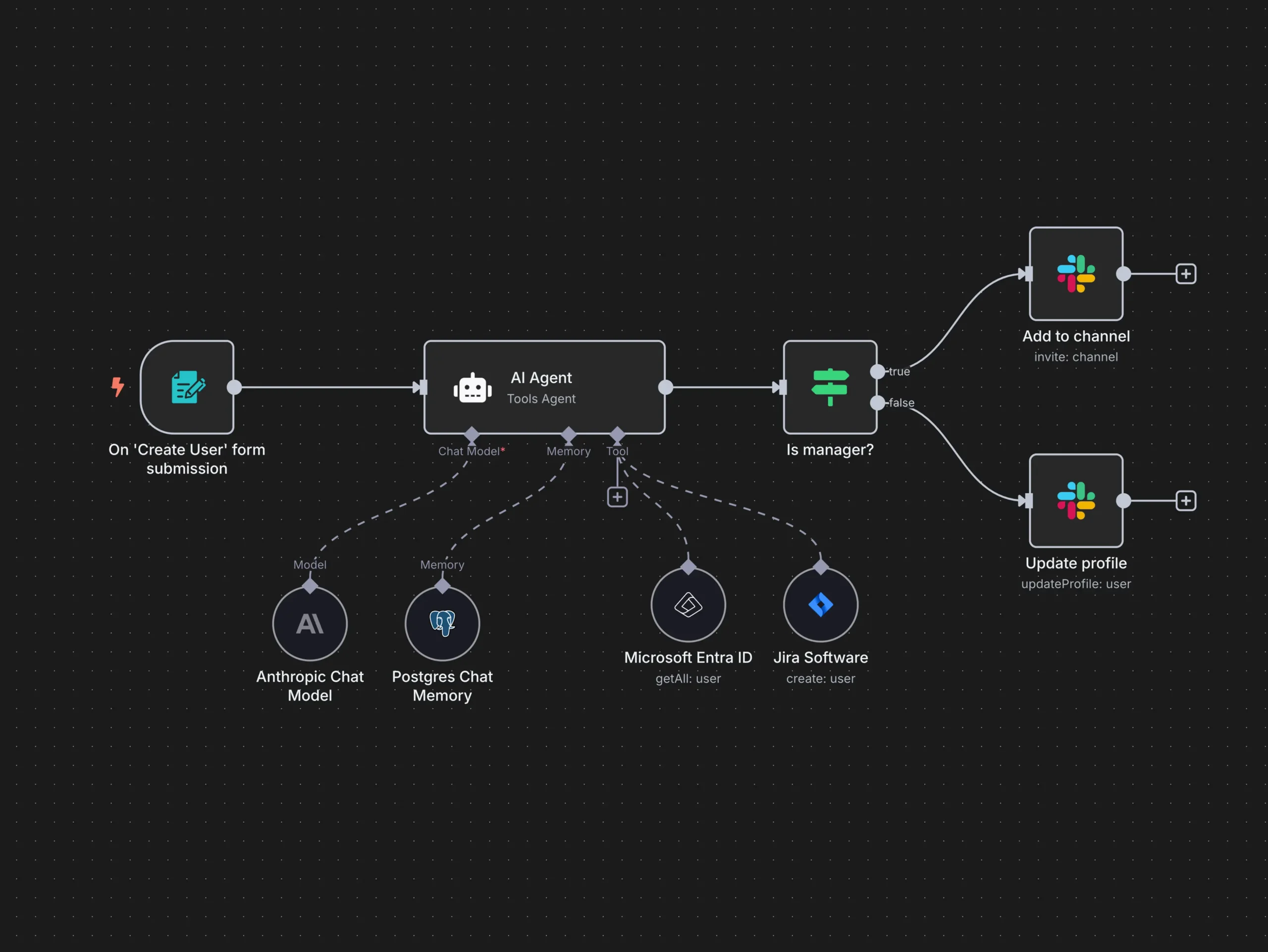
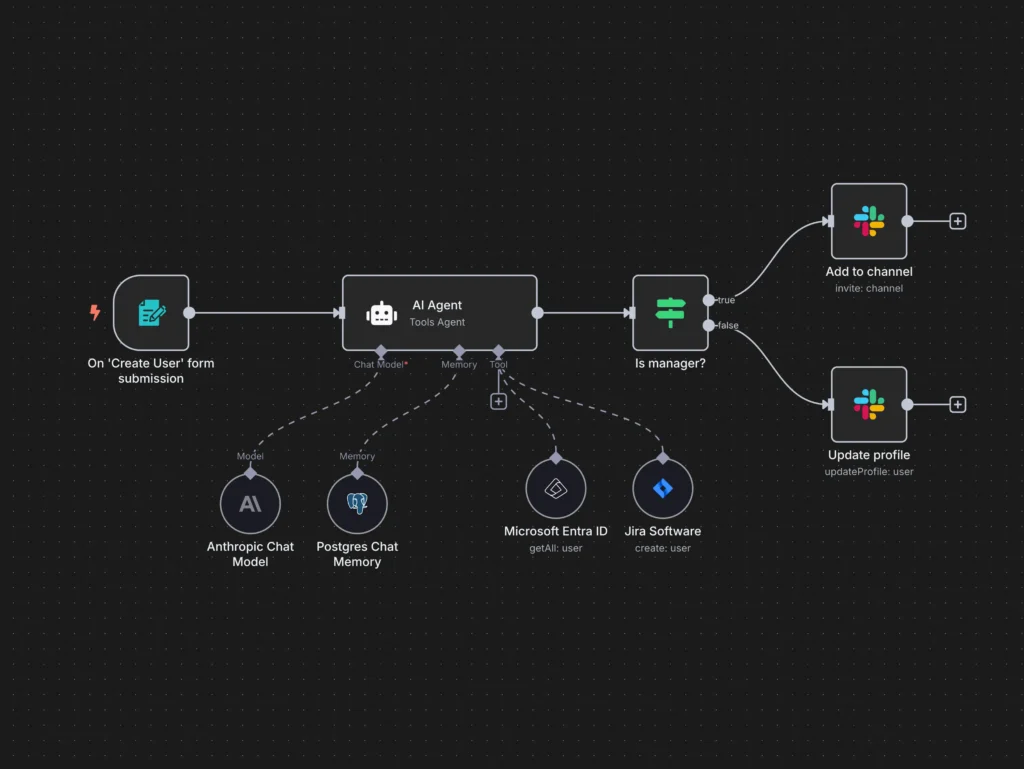
n8n is the workflow automation tool that does the connective tissue work between AI models and the systems a business already uses (CRMs, scheduling tools, email platforms, payment systems). It’s the difference between an AI chatbot that talks to a customer and a complete system that talks to the customer, books the appointment, updates the CRM, sends the confirmation text, and reminds the customer 24 hours ahead.
For an AI automation agency, n8n turns “we set up a chatbot” into “we built a system that runs your front desk.” That’s the difference between a $500/month engagement and a $2,500/month engagement. It’s also why specialized n8n automation agencies have become a search category in their own right.
Learn n8n. It’s the single highest-leverage tool in the stack.
What Separates the Agencies That Survive From the Ones That Don’t
A surprising number of AI automation agencies have started in the last 18 months. A surprising number have already closed.
The pattern in the survivors is consistent:
- They pick one industry and stay there long enough to develop genuine expertise. Generalists lose to specialists every time in service businesses.
- They charge real recurring fees, not just setup fees. Setup fees are a one-time spike. Recurring fees are the business. Agencies that only sell setup work are running on a treadmill.
- They keep their stack simple. Three tools used well beats fifteen tools used poorly.
- They focus on outcomes, not features. “We saved you $4,500 a month in front-desk costs and recovered 18 leads that would have gone to voicemail” beats “we set up an AI agent with multi-modal capabilities.”
- They sell to owners, not committees. Local service businesses have one decision-maker. Enterprise has eleven. Selling to one is dramatically faster.
The agencies that fail are usually trying to be enterprise consultants on day one, building custom software instead of implementing pre-built tools, or chasing every AI buzzword instead of doing the boring, profitable work of replacing $6,000/month employees with reliable AI systems.
Why Now Is the Window
According to McKinsey, 92% of companies have no clear AI strategy, and only 3% currently offer AI implementation services. While 99% of people wait for the “right time,” smart people are locking in clients now.
This window does not stay open forever. Right now, the supply of competent AI implementers is dramatically smaller than the demand from the 36 million small businesses in this country. That ratio is the entire opportunity.
In 2010, the same window existed for Facebook ad agencies. By 2014, it was crowded. By 2018, it was saturated. By 2022, it was a commodity. The operators who started in 2011–2012 built businesses the late entrants never caught.
We’re somewhere around the 2011–2012 moment for AI implementation. The first wave is in the water. The mass wave hasn’t hit yet. Anyone who started a Facebook ad agency in 2011 is now charging 5x what they could have charged in 2018, and they’ve spent the last decade compounding client relationships, case studies, and pricing power.
The same compounding is available right now, to anyone willing to learn the skill instead of buying into a business model that doesn’t have an exit.
A Realistic Comparison: Corporate Salary vs. AI Automation Agency
For the corporate professional reading this — currently earning $100K+ in a role you’re not sure will exist in three years — here’s the honest comparison.
Corporate path:
- $100K–$300K annual salary
- Single point of failure (one bad quarter, one new CFO, one restructuring)
- Income ceiling defined by your title
- 40–60 hours per week
- No equity, no asset you own
- Layoff risk that materially increases every year as AI eats more white-collar work
AI automation agency path:
- $0 in month one, possibly $5K–$15K in month three after first client
- 3–5 clients = full-time income working a few hours a week, typically reached in 6–12 months
- Income scales with client count, not title
- 10–20 hours per week at steady state
- You own the business as an asset
- Diversified across multiple clients, no single point of failure
Neither path is obviously better in every dimension. The corporate path offers stability if you stay employed. The agency path offers ownership if you do the work.
What’s no longer true is that the corporate path is automatically the safer one. The math on white-collar layoffs has changed permanently. A diversified small business with recurring revenue from five clients is now, in many cases, more stable than a single corporate role at a name-brand employer.
How to Move From Here
If this is the first time you’ve taken the AI automation agency model seriously, the practical next moves are simple:
- Pick your target industry. Spend 48 hours deciding. Don’t over-research.
- Spend the next 30 days learning Intercom AI, Helios AI, and n8n through their own documentation and free training.
- Build a one-page service description with your industry, your offer, and your pricing visible.
- Send 25 direct outreach messages to local business owners in your target industry. Not 1,000. Twenty-five, well-written, specific.
- Run the discovery calls that come back. Sign the first client. Over-deliver. Document everything.
That sequence — picked one industry, learned three tools, sent 25 messages, signed first client, over-delivered — is how almost every working AI automation agency in 2026 actually started.
The professionals who win in this space are not the ones with the most impressive backgrounds. They’re the ones who decided to learn a skill instead of buying into a business model that just stopped working. The window is open right now. The clients are out there right now. The only thing that’s missing is the operator who shows up.
That can be you. The math works. The model works. The timing works.
Pick the industry. Take the first step. If you want to see the playbook fully in action – tap here to start.